
OLLA LABREPORT No. 008
ISSUED
Gesha: Not one variety.
A name, with three different things under it.
- Subject
- GeshaGesha forest → Turrialba T2722 → Boquete
- Report type
- VARIETY DOSSIER · ETHIOPIA / PANAMA
- Method
- Cited source36
- OLLA Codex records2
- Editorial8
- Evidence grade
- AGrade A · disagreements and gaps flagged in place
- Issued
- Revised
- v12 · v12 · trilingual
- Report ID
- OLLA-LAB-008-v12
- Scope
- 16 sections · 46 figures · 181 sources
Key numbers
- COLLECTED
- 1930s
- ENTERED 1953
- T2722
- TO PANAMA
- 1963
- TOP LOT
- 30,204$/KG
© 2026 OLLA Brew Lab. All rights reserved.
Abstract
Gesha started out as material collected from a forest in Ethiopia in the 1930s. There are two accounts of the year, and the collector's name turns up only in later retellings. In 1953 it entered an introduction garden at Turrialba in Costa Rica and was registered as T2722. From 1963 it was sent out to Panama, yet nobody cupped it on its own until 2004. What is called Gesha today comes from at least three different sources. Its price has to be read in parts as well. The record is one lot; the market is all the others.
Key findings
Each finding is the answer that opens its section, quoted as written.
- F1
Gesha was collected from a forest in Ethiopia in the 1930s and was first cupped on its own in 2004. In 2025 one 20 kg lot of it sold for $30,204 a kilo.
1. At a glance Evidence: Fig. 1.1–1.4Cited source
- F2
Of 88 samples held as Gesha in the WCR database, only 39% matched CATIE's reference plant exactly when their DNA was compared.
2. One name, three things Evidence: Fig. 2.1–2.4Cited source
- F3
T2722 can be traced to a register entry dated 28 July 1953. Before that, the year of collection is given either as 1931 or as about 1936, and neither side has produced a document.
3. The road T2722 travelled Evidence: Fig. 3.1–3.3Cited source
- F4
By 2004 Gesha had been growing in Panama for 41 years. What changed that year was not the coffee. Someone separated it out for the first time, and a single lot of it took 35.51% of the whole auction's sales.
4. Planted, then discovered Evidence: Fig. 4.1–4.2Cited source
- F5
One Ethiopian farm grows three lines. One was selected to resemble the Panama line, one deliberately keeps the unevenness of the forest, and one comes from a 1974 expedition to a different forest.
5. The source is messier than the market Evidence: Fig. 5.1–5.3Cited source
- F6
Of five papers published since 2020, three point to the same thing. Material called Gesha does not all test as the same material, and even samples of the same name in germplasm collections differ from one another.
6. What the DNA says Evidence: Fig. 6.1–6.2Cited source
- F7
We could find a first-planting year backed by sources that meet our standard for only nine places. Two more rest on a single media report, and for twelve we found no record that meets the standard. The altitudes can be charted; the order in which places started cannot be drawn in full.
7. Where it grows now Evidence: Fig. 7.1–7.3Cited sourceOLLA Codex records
- F8
Over 23 editions of BOP, the year's top-priced Gesha set a new record 13 times, rising from $46.30 to $30,204 a kilo, and 7 of those records came from a single farm.
8. Twenty-three years of prices Evidence: Fig. 8.1–8.4Cited source
- F9
The top price in 2026 was 40.39% below 2025's, yet the median was 2.59 times 2025's, and even the cheapest lot sold for $1,504 a kilo.
9. No record in 2026, and still it cost more Evidence: Fig. 9.1–9.2Cited source
- F10
Since 2023 the correlation between score and price within the BOP Gesha category has been above 0.82 every year. That shows the rankings within the category line up; it does not show that high scores cause high prices.
10. Scores and prices Evidence: Fig. 10.1–10.2Cited source
- F11
From 2010 to 2024, Saza Coffee was on the list of winning bidders for the top-priced Gesha in 14 of 15 editions. In 2025 and 2026 each list had only one name left on it.
11. Who is buying Evidence: Fig. 11.1–11.3Cited source
- F12
The same name fetches prices an order of magnitude apart at a different auction. Panama's record is $30,204 a kilo, and the record at the source farm's own auction is $1,620.40.
12. Gesha at other auctions Evidence: Fig. 12.1–12.3Cited source
- F13
An auction price shows scarcity and how fierce the bidding was; on its own it cannot prove quality in the cup. The high price is six things stacked together, and only one of them can be checked on the cupping table.
13. What an auction measures, and the layers in the price Evidence: Fig. 13.1–13.3Cited sourceEditorial
- F14
At 15 g of roasted coffee per cup and 15% weight loss in roasting, the green coffee alone in the 2025 record lot costs $533.01 a cup at the auction price. For the 2026 median lot it is $53.28.
14. From the kilo to the cup Evidence: Fig. 14.1–14.2Cited source
- F15
Floral does not mean Gesha, heavy fermentation does not mean complexity, a record price is not the year's market, and “Gesha” on the bag does not mean T2722.
15. Common misreadings Evidence: Fig. 15.1–15.3Editorial
- F16
First see how much it can account for, then look at the price. A Gesha that cannot tell its own history has no grounds for being expensive.
16. What to ask before buying Evidence: Fig. 16.1–16.3Editorial
Section 01F1 ↑
1. At a glance
Finding F1
Gesha was collected from a forest in Ethiopia in the 1930s and was first cupped on its own in 2004. In 2025 one 20 kg lot of it sold for $30,204 a kilo.
This chapter only lists the readings, and each number gets a chapter of its own later on. The name has three spellings, Geisha, Gesha and Gori Gesha, and each spelling has a different history behind it, which chapter 02 goes through. World Coffee Research (WCR) is a non-profit that studies coffee varieties, and its variety catalog is a standard reference in the trade. The catalog has just one Gesha entry, called “Geisha (Panama)”.
Gesha's number, T2722, comes from an entry in a garden register dated 28 July 1953. The garden that received it was the coffee introduction garden that the Inter-American Institute for Cooperation on Agriculture (IICA) ran at Turrialba in Costa Rica, and CATIE looks after that collection today. CATIE itself was not founded until 1973, so the common line that it “went into CATIE in 1953” is not accurate. The literature writes the number as T2722, T.2722, T.02722 and T-2722, and all of them refer to the same material.
There are two accounts of the year it became famous. The Esmeralda farm's own account and the 2004 results table of the Specialty Coffee Association of Panama (SCAP) agree with each other, and both point to 2004. As of 26 September 2026 the WCR catalog still says 2005, and a 2024 genome paper repeats that 2005 after it. Our timeline uses 2004 and records 2005 alongside it.
Two prices
Best of Panama (BOP) is the competition and auction that SCAP holds every year. In 2025 its lot GW-01, 20 kg of washed Gesha from Hacienda La Esmeralda, sold for $30,204 a kilo.
We checked the auction platforms, the Cup of Excellence results pages for 11 countries, and reporting in Chinese, English and Japanese. As of 26 September 2026 we had found no higher sale price on public record. Privately negotiated sales and platforms inside China were outside the scope of our search.
The top price in 2026 was $18,004 a kilo, which did not break the record. But the median price of that year's 40 Gesha lots was $3,019 a kilo, against only $1,166.50 in 2025.
The median is the price in the very middle when all the lots are lined up by price; when the number of lots is even, it is the average of the middle two. The record is one lot; the market is all the others. Chapters 08 and 09 take this further.
- NAME
- Three spellings, Geisha, Gesha and Gori Gesha, each with its own history
- SOURCE
- A forest in south-western Ethiopia, collected in the 1930s; the year is given either as 1931 or as about 1936
- ACCESSION
- T2722, registered at the Turrialba introduction garden in 1953 and now in CATIE's care
- ROUTE
- Ethiopia → Kenya → Lyamungu → Turrialba → Panama
- TO PANAMA
- From 1963
- NAMED
- Top price at Best of Panama in 2004; WCR records 2005
SourceWorld Coffee Research variety catalog, Geisha (Panama); Anacafé variety guide 2020; Hacienda La Esmeralda official site; CATIE, Revista Forum Café 2020Cited source
30,204$/KG
Lot GW-01 at BOP 2025: 20 kg, 549 bids. As of 26 September 2026 we had found no higher price on public record.
SourceBest of Panama auction platform · Canvas of Terroir results page · 2025-08-07Cited source
3,019$/KG
Median of the 40 Gesha lots in 2026. In 2025 it was 1,166.50, and the record on the left is from a different year.
SourceBest of Panama auction platform, 2026 and 2025 results pages · median calculated by OLLACited source
- 1930sCollected in Ethiopian forestGiven as 1931 or as about 1936; neither has a document behind it
- 1953Registered as T2722IICA's introduction garden at Turrialba, now in CATIE's care
- 1963Reaches PanamaCATIE and Boot both give “from 1963”
- 1997Esmeralda buys the Jaramillo landGesha planted above 1,650 m
- 2004First processed plot by plotTop price at BOP, $21.00 a pound
- 2011Gesha Village leases land and collects seedSeed from the Gori Gesha forest
- 2017BOP opens a Gesha categoryEvery Gesha lot is on record from this year on
- 2025$30,204 a kiloOne 20 kg lot, still unbeaten in September 2026
- 2026No new recordThe median rises to $3,019 a kilo
SourceWCR variety catalog; Anacafé 2020; CATIE 2020; Hacienda La Esmeralda official site; Gesha Village official site; SCAP results, all years; Best of Panama auction platformCited source
Section 02F2 ↑
2. One name, three things
Finding F2
Of 88 samples held as Gesha in the WCR database, only 39% matched CATIE's reference plant exactly when their DNA was compared.
The catalog says it first
In the Geisha entry of its variety catalog, WCR writes that “there are multiple genetically distinct plant types that have been referred to as Geisha”. The sentence has not changed by a single word since 2023.
Here a variety catalog says, unprompted, that one of the names it lists does not point to one consistent thing. This dossier starts from there.
Three things
The first is the line that can be traced to T2722, and the Panama Gesha that WCR describes comes from it. The second is the wild population in the forests around Gori Gesha in south-western Ethiopia, which was never uniform in the first place. At the source, the Gesha Village farm grows a line specifically to keep this forest's genetic diversity, as chapter 05 explains.
The third is material sold elsewhere under the Gesha name, some of it with a well-documented history and some with very little. A study published in July 2026 found one case in Ecuador. A farm had paid $500 a kilo for “Gesha” seed, and when it was tested with 11 SSR markers it turned out to be a different Ethiopian landrace, much like T.02722 but not the same.
SSR markers are short sequences repeated along stretches of DNA, and they are commonly used to check whether two samples share a source. The paper's authors call this material “Evangelina” for now, and note that the name is used only for tracing within the farm.
Where the 39% comes from
In 2020 Pruvot-Woehl and colleagues tested 2,533 samples with 8 SSR markers, and 88 of them were held as Gesha in the WCR database. Of those, 39% matched CATIE's reference plant T.2722 exactly, 24% were very close and belonged to the same Gesha genetic group, and 37% had a genetic background unrelated to Gesha. WCR's 2020 press release cites the same 39%.
These 88 samples were ones sent in to the WCR database, not drawn in proportion to the market, so the 39% cannot be read as “61% of the Gesha on sale is fake”. What it does show is something else. Until it has been tested, material called Gesha cannot be assumed to be T2722.
The spellings
WCR's explanation is that the earliest germplasm records spelled this material Geisha, and research institutions have kept that spelling ever since. The mountain near where it was collected is usually spelled Gesha in English, and the two spellings are interchangeable.
Gori Gesha is a forest in the West Omo Zone, a different place from the Gesha district in the Kafa Zone. The Gesha Village home page says West Omo, while its page The Village still gives the old zone name, Bench Maji.
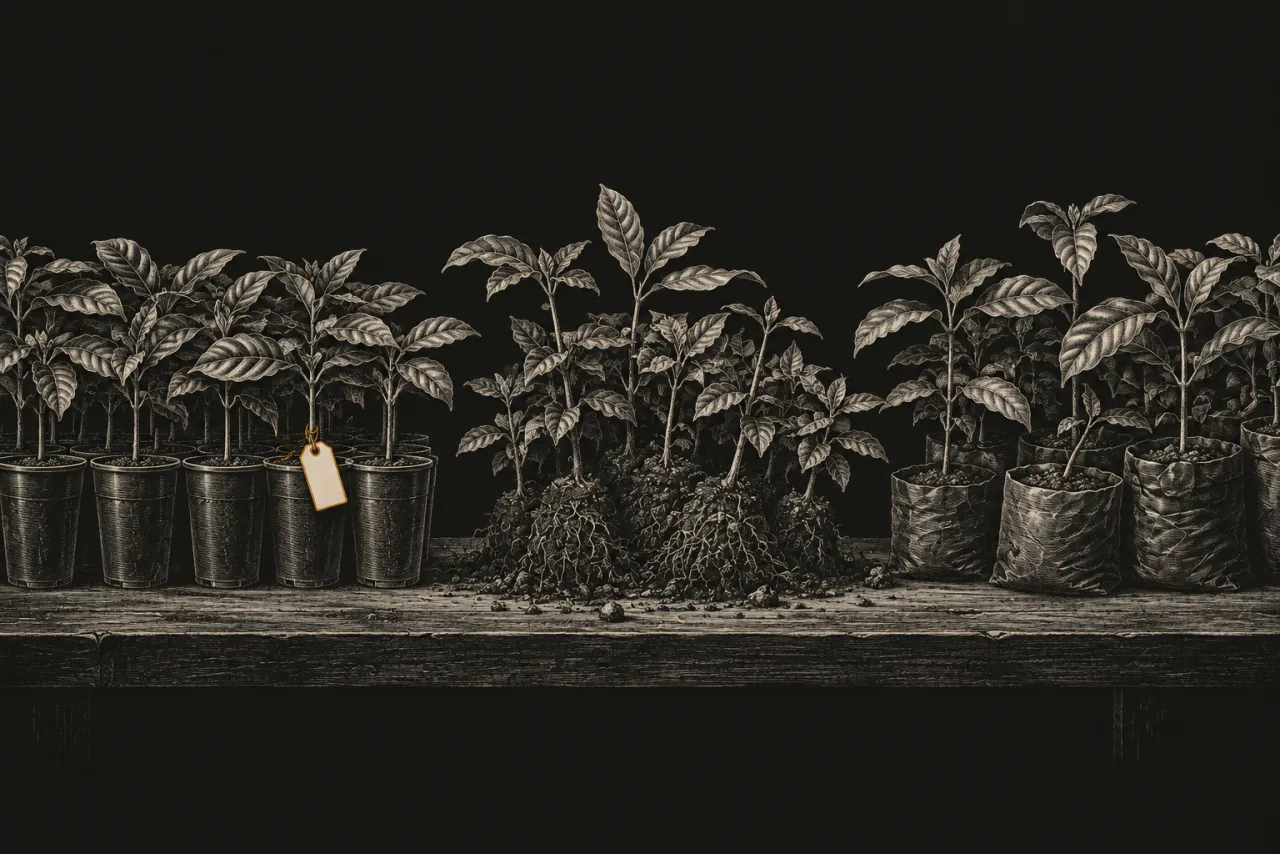 T2722FORESTOTHER
Plate 1Figure 2.1
One name, three things
Three groups of material from different sources, sharing one name.
- T2722
- Left: the line that can be traced to the 1953 accession number
- FOREST
- Centre: the wild population in the source forest, never uniform to begin with
- OTHER
- Right: material planted or sold elsewhere under the Gesha name, some well documented and some barely
SourceWCR variety catalog; Gesha Village official site; Tapia-Armijos et al. 2026Cited source
Exact match with T.272239%
Very close, same Gesha genetic group24%
Genetic background unrelated to Gesha37%
Figure data
| Group | Count |
|---|---|
| Exact match with T.2722 | 39 |
| Very close, same Gesha genetic group | 24 |
| Genetic background unrelated to Gesha | 37 |
SourcePruvot-Woehl et al., J. AOAC Int. 103(2):325–334, 2020; WCR news, 2020-03-23 · values as publishedCited source
SourceWCR variety catalog; Gesha Village official site; Tapia-Armijos et al. 2026; Pruvot-Woehl et al. 2020 · grouping by OLLA's editorsCited source
Geisha · Gesha · Gori Gesha
- Geisha
- The earliest spelling in the germplasm records, the one research archives and Panama have always used
- §03
- Gesha
- The usual English spelling of the mountain near the collecting site; WCR says the two spellings are interchangeable
- §03
- Gori Gesha
- A forest in the West Omo Zone, and also the name of one Gesha Village line. It is not the Gesha district in the Kafa Zone
- §05
SourceWCR variety catalog; Gesha Village official site; BMC Plant Biology 2025Cited source
Section 03F3 ↑
3. The road T2722 travelled
Finding F3
T2722 can be traced to a register entry dated 28 July 1953. Before that, the year of collection is given either as 1931 or as about 1936, and neither side has produced a document.
The day it arrived
WCR records the route like this. The material was collected from Ethiopian coffee forest in the 1930s, went first to the Lyamungu research station in Tanzania, and reached Central America in 1953, where it was registered as T2722.
Anacafé, Guatemala's coffee association, gives the day of arrival in its 2020 variety guide. It was 28 July 1953, and the material was received by IICA's coffee introduction garden at Turrialba. CATIE's own publication wrote in 2020 that it entered CATIE's international coffee collection from Tanzania in 1953, using the institution's present-day name.
Further back, two chronologies
One account says 1931. Writing in Roast magazine in 2006, Willem Boot passed on the findings of Labouisse, a researcher at the French agricultural research body CIRAD. On this account the material was collected in 1931, sent to the Kitale research centre in Kenya between 1931 and 1932, and planted in 1936 at two research stations, Kawanda in Uganda and Lyamungu in Tanzania.
The other account says about 1936. Hacienda La Esmeralda's official site and the 2024 genome paper by Medrano and colleagues both put it this way, saying the material went first to Kenya and then to Tanzania. The Medrano paper cites an article Boot wrote in 2013.
In 2017 Daily Coffee News mentioned a 1936 letter from the British consulate that refers to Geisha Mountain several times. WCR says only “1930s” and does not name a collector.
The collector most often named in these retellings is Richard Whalley, the British consul for the Bench Maji area, and Esmeralda says he was instructed to collect about 10 pounds of seed. His name appears only in the line of retellings that runs through Esmeralda and Boot. We found no original document from the 1930s, and neither the consular reports nor the records of Kenya's agriculture department have been made public, so we do not state it as fact. Gesha Village named one of its lines “Gesha 1931” to commemorate that expedition, and the name is not independent evidence for the date.
To Panama
CATIE's 2020 article says it was distributed to Panama from 1963. Boot wrote in 2006 that it was Francisco “Don Pachi” Serracín who brought it into Panama in 1963. In 2017 Daily Coffee News quoted Price Peterson, who also named Serracín.
WCR says “1960s”, and Medrano 2024 says the mid-1960s. We write “from 1963”, and following Boot and Peterson we record the person who introduced it as Serracín.
Why it was planted, and why it was then neglected
WCR says it was distributed to Panama via CATIE “after it had been recognized for tolerance to coffee leaf rust”. But leaf rust was first reported in the Americas only in 1970, in Brazil, and it spread through Central and South America in the 1970s and 1980s.
So any claim in the 1950s or 1960s that it tolerated rust can only have come from tests in a germplasm garden, an experimental plot kept to conserve and test planting material. Panama's coffee farms had no leaf rust at the time.
Esmeralda tells it differently again. Its official site says that what actually brought the seed to the farm was Gesha's resistance to ojo de gallo, a leaf-spot disease of the Americas. Among the sources we read for this issue, none says it was introduced back then because it tasted good.
Why nobody went on to grow it is also on record. WCR writes that its branches are brittle and farmers did not like it, so it was never planted widely. In a 2014 bulletin the Costa Rican agronomist Ramírez wrote that multi-site trials from 1963 onwards followed it over 7 harvests, that its yield showed no clear difference from the Typica control, and that the conclusion in the 1970s was not to recommend it unless the price made up for the low yield. This rests on that one source only.
WCR also changed its ratings in October 2025. Yield potential went from Medium to Low, and leaf rust from Tolerant to Intermediate resistance. The leaf rust change may simply be a site-wide renaming of the label, so it cannot be read as saying that Gesha has become less resistant.
 1930sKENYALYAMUNGUTURRIALBA 1953PANAMA 1963
Plate 2Figure 3.1
The road one accession number travelled
WCR lists four stops, the forest, Lyamungu, Turrialba and Panama. The Kenya stop appears in both the 1931 and the about-1936 retellings.
- The order in which the records hand it on, not a road on a map
- Found only in retellings; WCR does not list it
SourceWCR variety catalog; Anacafé 2020; Boot, Roast 2006; Medrano et al. 2024; CATIE 2020Cited source
1931The 1931 account
Boot, writing in Roast in 2006, passing on CIRAD's Labouisse. On this account it was collected in 1931, sent to Kitale in Kenya between 1931 and 1932, and planted at Kawanda in Uganda and Lyamungu in Tanzania in 1936.
1936The about-1936 account
Given by the Esmeralda site and by the 2024 paper by Medrano et al.: first to Kenya, then to Tanzania. The collector in these retellings is the British consul Richard Whalley, but no document has been seen.
GAPWhat both accounts lack
WCR says only 1930s. Neither account can produce an original document from the 1930s.
SourceBoot, Roast 2006; Hacienda La Esmeralda official site; Medrano et al., G3 2024; Daily Coffee News 2017; WCR variety catalogCited source
SourceWCR current page and archived copies from 2023-06, 2025-06 and 2025-10; Talhinhas et al. 2017; Hacienda La Esmeralda official site; Ramírez 2014Cited source
Section 04F4 ↑
4. Planted, then discovered
Finding F4
By 2004 Gesha had been growing in Panama for 41 years. What changed that year was not the coffee. Someone separated it out for the first time, and a single lot of it took 35.51% of the whole auction's sales.
It had been there all along
Gesha had been in Panama since 1963, as chapter 03 showed. In 1997 Hacienda La Esmeralda bought the land that later became the Jaramillo farm and planted Gesha on plots above 1,650 m. Its official site says this was higher than anyone had grown Gesha before. The site does not say in which year the first Gesha was planted at Jaramillo, so we cannot work out how many years passed on this farm between planting and recognition.
What happened in 2004
By Esmeralda's account, to enter that year's competition the Peterson family, for the first time, “separated production from different areas of the farm into individual lots” during processing, in the words of its official site. Until then the coffee from all the plots had been processed together.
SCAP's 2004 results table lists 11 lots in all. The highest price went to PA101, “Jaramillo Special”, at $21.00 a pound, or $46.30 a kilo. The lot was 7 bags of 60 kg each, 420 kg in total.
It sold for $19,445.16 in all, 35.51% of the auction's total of $54,755.98. The other 10 lots fetched only $1.25 to $2.53 a pound, and the top price was 8.30 times the second.
PA101 was won by The Roasterie, Public Market Coffee and Groundwork Coffee. A note under the table says they had agreed to share the lot with Intelligentsia, G.H. Howell, Stumptown and Sweet Maria's, one bag for each of the 7 companies.
The results table does not name the variety. Identifying Jaramillo Special as Esmeralda's Gesha is our judgement, based on Esmeralda's own account: it says it won in 2004 with Gesha, and Jaramillo is its farm. A 2010 retrospective gives the price as $20 a pound, and we go by SCAP's results table.
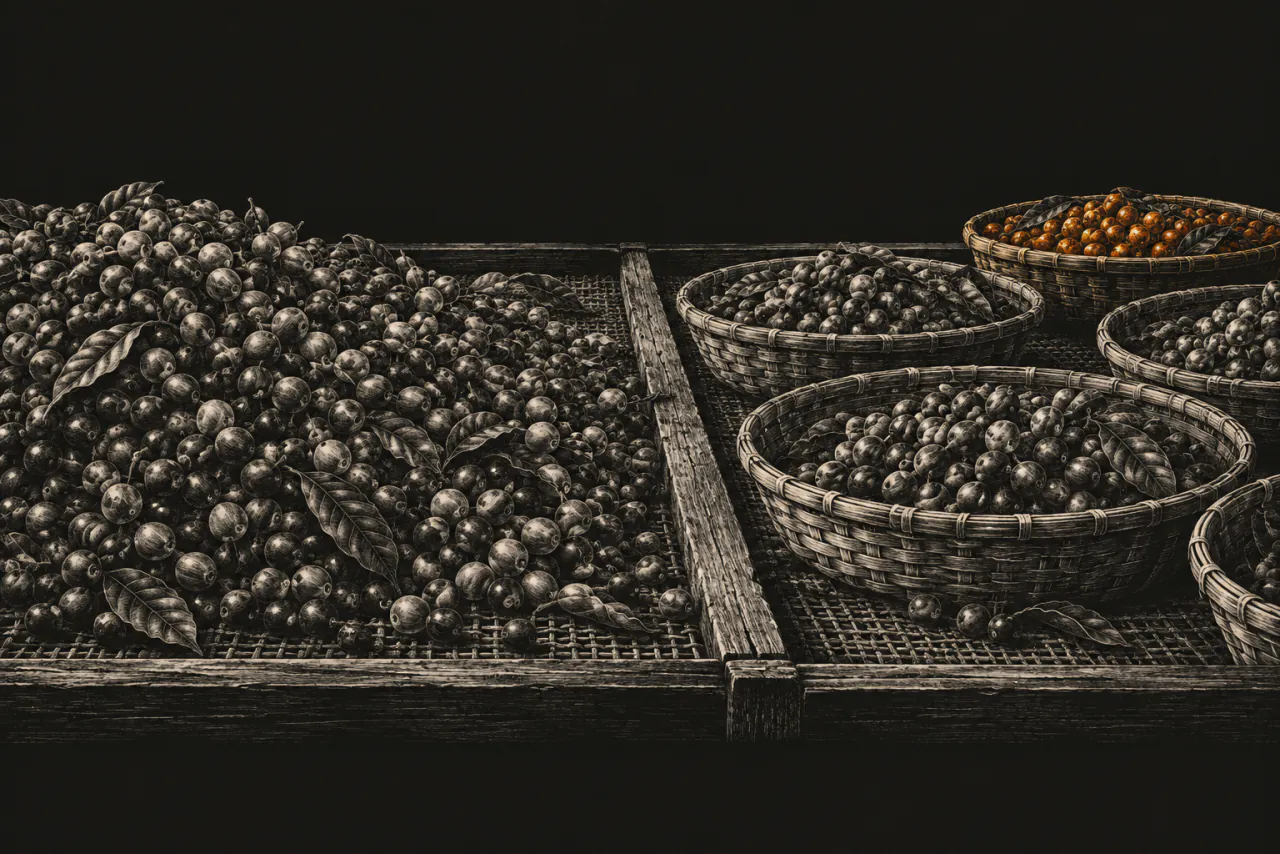 BEFORE 20042004
Plate 3Figure 4.1
Mixed and separated
The same farm and the same season's cherries; the only difference is whether they were kept apart during processing. The number of heaps and baskets in the picture does not stand for the number of plots.
- LEFT
- Cherries from all the plots are processed together, so no single plot can be tasted on its own
- RIGHT
- Processed plot by plot, and the high plot reaches the cupping table on its own for the first time
SourceHacienda La Esmeralda official siteCited source
- Jaramillo Special$21.00
- Don Pachi Estate$2.53
- Café Leru$2.30
- Café De Eleta$2.20
- Lerida Estate$2.15
- Cafetales Doña Berta$2.04
- Café Don Pepe$1.92
- La Victoria Estate$1.90
- Arkapal Premium$1.85
- Gian Panamá$1.26
- Sohel Café$1.25
Figure data
| Item | Value | Rank |
|---|---|---|
| Jaramillo Special | 21 | $21.00 |
| Don Pachi Estate | 2.53 | $2.53 |
| Café Leru | 2.3 | $2.30 |
| Café De Eleta | 2.2 | $2.20 |
| Lerida Estate | 2.15 | $2.15 |
| Cafetales Doña Berta | 2.04 | $2.04 |
| Café Don Pepe | 1.92 | $1.92 |
| La Victoria Estate | 1.9 | $1.90 |
| Arkapal Premium | 1.85 | $1.85 |
| Gian Panamá | 1.26 | $1.26 |
| Sohel Café | 1.25 | $1.25 |
SourceSCAP · Best of Panama 2004 Final Results · 2004-07-03 (Wayback archive) · values as publishedCited source
Section 05F5 ↑
5. The source is messier than the market
Finding F5
One Ethiopian farm grows three lines. One was selected to resemble the Panama line, one deliberately keeps the unevenness of the forest, and one comes from a 1974 expedition to a different forest.
Gesha Village's dates
Gesha Village is in south-western Ethiopia, and the home page of its official site says the West Omo Zone. The site gives no founding year. In 2011 it signed the lease on its land, as Barista Magazine and Daily Coffee News reported in 2017. In the same year the farm collected seed from the Gori Gesha forest about 20 km away, as its own site says.
The Our Story page of the site is signed by Adam Overton, Rachel Samuel and Willem Boot. The farm covers 471 hectares in all. The site gives the planted area in two places, once as 320 hectares and once as 341, and the eight blocks add up to 321.3 hectares. The altitude runs from 1,909 to 2,069 m.
The three lines
The site's variety page describes the three lines in very different terms. Gesha 1931 was selected from the diverse forest population for its resemblance to the Panama Gesha, judged on how the plants look, the shape of the beans and the cup.
Gori Gesha is meant to reproduce the genetic diversity within the Gori Gesha forest, and its seed was collected on the farm's own expedition in 2011. Illubabor Forest is a cultivated line from an Ethiopian research centre, selected from a 1974 expedition to the Illubabor coffee forest, and the site says it is disease-resistant.
So even at the source, “Gesha” does not point to one thing. One line was selected to match the Panama line, one was deliberately left unselected, and one comes from another forest.
The site also says that historical research and genetic testing have confirmed that the Gori Gesha forest where it collected seed is where the Panama Gesha was originally collected. The test data have not been published, so we record this only as the farm's claim.
Eight blocks
Each of the eight blocks grows one line. Gori Gesha is planted in Shewa-Jibabu, Shaya and Bangi, Gesha 1931 in Surma, Oma and Narsha, and Illubabor Forest in Dimma and Gaylee. These block names often turn up in the lot names at the Pride of Gesha auction, which chapter 12 draws on.
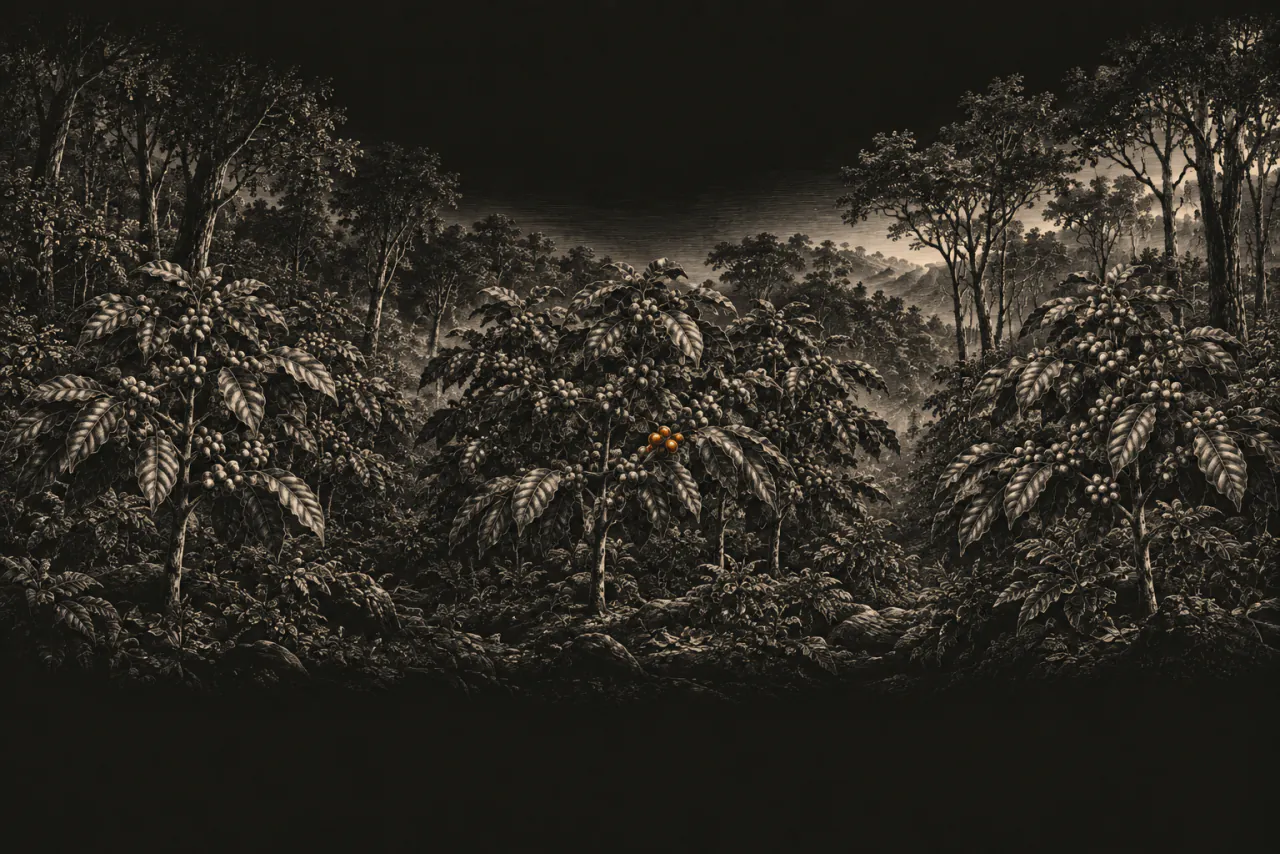 GESHA 1931GORI GESHAILLUBABOR
Plate 4Figure 5.1
Three lines at the source
One farm, three materials with different histories. The differences in tree shape in the picture are not traits of the lines.
SourceGesha Village official site, variety pageCited source
| LINE | WHAT THE SITE SAYS |
|---|---|
| Gesha 1931 | Selected from the forest population for resemblance to the Panama Gesha, judged on plant, bean shape and cup |
| Gori Gesha | Reproduces the genetic diversity within the Gori Gesha forest; seed from the farm's own 2011 expedition |
| Illubabor Forest | A cultivated line from an Ethiopian research centre, selected on a 1974 expedition to the Illubabor coffee forest; the site says it resists disease |
SourceGesha Village · The VillageCited source
| BLOCKS | LINE | ALTITUDE m | AREA ha |
|---|---|---|---|
| Shewa-Jibabu | Gori Gesha | 1,973–2,069 | 48.5 |
| Shaya | Gori Gesha | 1,926–2,069 | 36.5 |
| Bangi | Gori Gesha | 1,911–2,001 | 54 |
| Surma | Gesha 1931 | 1,909–2,063 | 45.9 |
| Oma | Gesha 1931 | 1,931–2,040 | 67.6 |
| Narsha | Gesha 1931 | 1,963–1,977 | 5.3 |
| Dimma | Illubabor Forest | 1,966–2,019 | 28.7 |
| Gaylee | Illubabor Forest | 1,916–1,982 | 34.8 |
SourceGesha Village · block table on The Village page · values as published; total calculated by OLLACited source
Section 06F6 ↑
6. What the DNA says
Finding F6
Of five papers published since 2020, three point to the same thing. Material called Gesha does not all test as the same material, and even samples of the same name in germplasm collections differ from one another.
This chapter goes through the papers one at a time. For each, it says only what was tested and what was found, and claims nothing further on the paper's behalf.
Three papers find it uneven
The 2020 paper by Pruvot-Woehl and colleagues appeared in J. AOAC Int. They tested 2,533 samples with 8 SSR markers, and of the 88 held as Gesha, only 39% matched the reference plant T.2722 exactly, as chapter 02 described.
The 2024 paper by Scalabrin and colleagues appeared in Nature Communications. The T.02722 they obtained from CATIE has a stretch on chromosome 1 whose structure differs from the other samples, which the paper describes as a heterozygous homoeologous exchange. Neither the public Geisha data nor the Geisha sample supplied by WCR has this stretch. On this basis the authors point out that germplasm of the same name can differ structurally in this way.
The paper by Tapia-Armijos and colleagues appeared in Frontiers in Plant Science on 14 July 2026. A farm in Loja, Ecuador, had bought “Gesha” seed at $500 a kilo, and when it was tested with 11 SSR markers it proved to be a different Ethiopian landrace, similar to T.02722 but not the same.
The other two are about something else
The 2024 paper by Salojärvi and colleagues in Nature Genetics did not assemble a Gesha genome. It reaches two conclusions that bear on Gesha. One is that the recently established Geisha cultivar is admixed in both of its subgenomes and resembles about half of the wild material. The other is that the area around Gesha mountain holds a concentration of wild material suited to domestication.
In 2024 Medrano and colleagues published the first chromosome-level Gesha genome in G3, 1.03 Gb in size. The tree they sampled grows at Goodland Organics in Goleta, California, from seed that Price Peterson sent from Panama in 2006. It is the genome of one tree, and it cannot tell us whether other trees called Gesha are the same.
Two claims with no paper behind them
The WCR catalog says that recent genetic diversity analyses confirm the Panamanian line descended from T2722 is “distinct and uniform”, meaning different from other material and consistent within itself. It gives no source for these analyses.
On 20 August 2026 the EFE news agency put out a wire story that many outlets reprinted. It said SCAP had announced a comparison carried out in France, and quoted its lead, Christophe Montagnon, as saying that Panama's Gesha and CATIE's original material are genetically identical: “la genética es exactamente la misma”.
Neither the method, nor the number of samples, nor a paper has been published for this comparison. Both claims can be cited only as statements by the institutions, not as research findings.
They do not contradict each other
The 39% study tested samples that were held as Gesha, whereas WCR and SCAP are reportedly talking about Panama's T2722 line. The two tested different things, so both can be true at once.
Read together, they make the statement that Gesha is not one variety stronger. Under the one name there are at least the T2722 line, the source forest population, and other Ethiopian landraces sold as Gesha, such as “Evangelina”. That is our judgement.
Pruvot-Woehl 2020
Of 88 samples held as Gesha, only 39% matched T.2722 exactly.
Tested 2,533 samples with 8 SSR markers. It says nothing about proportions on the market.
Scalabrin 2024
CATIE's T.02722 carries a chromosome structure that the other Geisha samples lack.
Compared genome data from three Geisha samples. It does not say which one is the genuine article.
Tapia-Armijos 2026
A batch of “Gesha” seed in Ecuador was in fact a different Ethiopian landrace.
Tested material from one farm with 11 SSR markers. It says nothing about other Gesha in Ecuador.
Salojärvi 2024
The Geisha cultivar is admixed, and the Gesha mountain area holds a concentration of wild material suited to domestication.
Studied genomes across the arabica population. It did not assemble a Gesha genome.
Medrano 2024
The first chromosome-level Gesha genome, 1.03 Gb.
Sequenced one tree in California, grown from Panamanian seed. It does not say other Gesha trees are the same.
SourceJ. AOAC Int. 2020; Nature Communications 2024; Frontiers in Plant Science 2026-07-14; Nature Genetics 2024; G3 2024Cited source
- 2020-0339%Pruvot-Woehl et al. and WCR's press release
- 2024-01Same-named germplasm, different structureScalabrin et al.
- 2024-04Geisha is admixedSalojärvi et al.
- 2024-11First Gesha genomeMedrano et al.
- 2025-10WCR changes its ratingsYield to Low, leaf rust to Intermediate resistance
- 2026-07-14“Evangelina”Tapia-Armijos et al.
- 2026-08-20SCAP says genetically identical (news, unpublished)A wire story only, no paper; neither the method nor the sample size has been published
SourceThe papers; WCR news, 2020-03-23; archived WCR pages; EFE wire story, 2026-08-20 (reprinted by swissinfo)Cited source
Section 07F7 ↑
7. Where it grows now
Finding F7
We could find a first-planting year backed by sources that meet our standard for only nine places. Two more rest on a single media report, and for twelve we found no record that meets the standard. The altitudes can be charted; the order in which places started cannot be drawn in full.
The earliest documented planting
Meeting the standard here means having at least one primary source, or two secondary sources independent of each other. By that standard we can give a year for nine places.
Costa Rica comes first, in 1953, at IICA's introduction garden in Turrialba. Panama follows from 1963. Mexico's year is 1980, when the Mexican Coffee Institute, INMECAFE, introduced it. California's is 2006, when Price Peterson sent seed to Goodland Organics.
Thailand's is 2010, when Doi Chaang trial-planted 40 to 50 Ethiopian seeds. In Hawaii the seed entered the United States in 2010 and was trial-planted on Maui in 2011. In Ethiopia, Gesha Village collected its seed in 2011.
Yunnan's is 2013, when the Yunnan Academy of Agricultural Sciences brought in a small amount from Panama. The report was published in two places, and elsewhere in the text the institution is named as the Academy of Social Sciences.
For Colombia all we can fix is a lower bound, after 2008. Café Granja La Esperanza's official site says it leased La Carleida in Panama in 2007 and won first place at BOP a year later. “At this point”, the site says, came the decision to bring Geisha seed back to Colombia. The original gives no year. “After 2008” is our inference, and an earlier introduction cannot be ruled out.
Brazil and Taiwan each have only one report in the trade press, which falls short of the standard. The Brazilian one says it entered the germplasm collection of the IAC institute between 1952 and 1953, and the Taiwanese one says 2014. For Peru, Guatemala, Honduras, El Salvador, Nicaragua, Ecuador, Bolivia, Malawi, Rwanda and Burundi, Vietnam, Indonesia and Australia we found no first-planting year that meets the standard.
Malawi needs a word of its own. WCR says Geisha is “cultivated widely” there. A handbook from the Coffee Association of Malawi says the line promoted locally was a single-plant selection from “Geisha 56”, chosen for its resistance to Fusarium wilt, but it gives no year.
The altitudes, laid out
The OLLA Codex keeps its own directory of Gesha farms. Calculated from version 607 of the Codex, the directory lists 51 farms, 38 of which have an altitude range on record. They are spread across 17 countries and regions and run from 737 m to 2,500 m.
The chart includes the 10 countries that have two or more farms on record. Panama has 7, between 1,300 and 2,000 m. Gesha Village at the source sits at 1,909 to 2,069 m, and it is the horizontal band in the chart.
These numbers will be revised along with the Codex. Of the farm records used in the July chart, several have since been withdrawn from the Codex or had their altitude changed.
No ruler yet
This chart cannot be read as showing where Gesha does better. It shows the altitude ranges of farms or growing regions, not the altitude of the plots where the Gesha grows. In a region that runs from low ground to high, the Gesha may be planted only on the highest plot.
Nor were these origins cupped on a common form. Each impression comes from a different table, different judges and a different roast level. Add what chapters 02 and 06 describe, that the material introduced in each place may not be the same. That is our judgement.
- 1953Costa RicaIICA's introduction garden at Turrialba
- 1963PanamaCATIE and Boot both give “from 1963”
- 1980MexicoIntroduced by INMECAFE
- 2006California, USPrice Peterson sends seed to Goodland Organics
- After 2008ColombiaInferred lower bound; an earlier introduction cannot be ruled out
- 2010ThailandDoi Chaang trial-plants 40 to 50 seeds
- 2010–2011Hawaii, USSeed enters in 2010, trial planting the next year
- 2011EthiopiaGesha Village collects seed
- 2013China YunnanThe Yunnan Academy of Agricultural Sciences introduces it from Panama
- No yearOne media report onlyBrazil, Taiwan
- No yearNo record meeting the standardPeru, Guatemala, Honduras, El Salvador, Nicaragua, Ecuador, Bolivia, Malawi, Rwanda and Burundi, Vietnam, Indonesia, Australia
SourceCATIE 2020; Anacafé 2020; Boot, Roast 2006; the article on the INMECAFE introduction; Medrano et al. 2024; Doi Chaang; Monarch Coffee; Gesha Village official site; Baoshan Daily · the Colombia row is OLLA's inferenceCited source
- Bolivian=2160025001600–2500 m
- Perun=3175022001750–2200 m
- Costa Rican=3165021901650–2190 m
- Ecuadorn=2150021001500–2100 m
- Panaman=7130020001300–2000 m
- Guatemalan=4130019201300–1920 m
- China (Yunnan)n=37371800737–1800 m
- Hondurasn=3145017501450–1750 m
- Vietnamn=2140016501400–1650 m
- Braziln=29001450900–1450 m
SourceOLLA Codex farm records · version 607 · 38 Gesha farms with an altitude on recordOLLA Codex records
- FARMS
- 38 with an altitude on record, of 51 in the directory
- ORIGINS
- 17, of which 10 have two or more farms
- SPREAD
- 737 to 2,500 m
- VERSION
- OLLA Codex version 607; it changes when the Codex is revised
- MISSING
- A cupping comparison. There is no standard shared across origins, so this field is empty
SourceOLLA Codex · version 607OLLA Codex records
Section 08F8 ↑
8. Twenty-three years of prices
Finding F8
Over 23 editions of BOP, the year's top-priced Gesha set a new record 13 times, rising from $46.30 to $30,204 a kilo, and 7 of those records came from a single farm.
How the line is drawn
Before 2017 Best of Panama had no separate Gesha category. The official results give only lot names, and in some years the category codes mix in other varieties such as Pacamara. So for 2004 to 2016 we can take only one lot a year, the highest-priced lot that year that can be shown to be Gesha.
What identifies the lot as Gesha differs from year to year. Sometimes Geisha is in the lot name, sometimes it is contemporary reporting, sometimes what the winning bidder said on the day, and sometimes the farm's own account. For the 2009 “Esmeralda Special” there is no contemporary report, and we infer that it was Gesha from the name of the series it belongs to. From 2017 there is a Gesha category, and every lot is on record.
2008 is a gap. The top price that year was for PA2008-01, “La Carleida / Café Granja La Esperanza”, at $47.00 a pound. The official results graphic does not give the variety, and the farm itself says only that it won, not what variety it was. So for 2008 we record the highest-priced lot with Geisha in its name, at $22.00 a pound. For the 2013 top price, SCAP's results graphic says $350.25 a pound and a 2018 Lamastus blog post says 350.75; we go by the results graphic.
Thirteen times
In nominal dollars, the year's top Gesha beat every earlier year in 2004, 2006, 2007, 2010, 2013, 2017, 2018, 2019, 2020, 2021, 2023, 2024 and 2025, 13 times in all. The 2026 price of $18,004 a kilo did not break the record.
Of those 13, Hacienda La Esmeralda set 7, Elida and the Lamastus family 3, and Finca Sophia, Finca Nuguo and Carmen Estate 1 each. Across all 23 editions, the year's top Gesha came from Esmeralda 10 times and from Elida and Lamastus 5 times; the other 7 came from a different farm each, and 2008 is undetermined.
The 2025 price of $30,204 a kilo is 652.4 times the $46.30 of 2004. That is a ratio of nominal prices, not adjusted for inflation.
The top lot keeps shrinking
The weight of the top lot has fallen all the way. It was 420 kg in 2004 and 226.80 kg in 2007. From 2011 to 2022 it was 100 pounds, or 45.36 kg. It was 25 kg in 2023, 20 kg in 2024 and 2025, and only 15 kg in 2026.
Its share of the whole auction's sales was 35.51% in 2004, 46.17% in 2007, 45.94% in 2010 and 21.11% in 2025. In 2026 it was only 8.88%, the lowest since the Gesha category began. The share was also low in 2011, 2012, 2014 and 2016, between 4.37% and 7.65%, but a lot was then only 100 pounds and prices were low, so those years do not compare directly with today. The 2013 and 2015 results graphics give no auction total, and we did not add the rows up ourselves, so those two years are left blank.
Since 2017 the Gesha category has taken between 86.26% and 93.64% of the auction's sales each year, and 90.41% in 2026. In other words, the Best of Panama auction today is essentially a Gesha auction. The auction totals for 2016 to 2018 are our own sums of every lot, with no official figure to check them against.
- Hacienda La Esmeralda
- Elida · Lamastus
- Other farms
- 2008, see note
- Record-setting years
USD/kg · log scale
- a 2008 · A lot with Geisha in its name. The variety of the overall top lot is undetermined.
The year's top-priced Gesha lot · 2004–2026 · USD/kg · log scale. The values are in the data table below the chart.
Figure data · USD/kg
| The year's top-priced Gesha lot | |
|---|---|
| 2004 | 46.30 · $21 a pound, 420 kg lot |
| 2005 | 44.31 · $20.10 a pound, 480.01 kg lot |
| 2006 | 110.78 · $50.25 a pound, 300.01 kg lot |
| 2007 | 286.60 · $130 a pound, 226.8 kg lot |
| 2008 | 48.50 · $22 a pound, 181.44 kg lot |
| 2009 | 157.63 · $71.50 a pound, 158.76 kg lot |
| 2010 | 375.23 · $170.20 a pound, 181.44 kg lot |
| 2011 | 245.82 · $111.50 a pound, 45.36 kg lot |
| 2012 | 205.58 · $93.25 a pound, 45.36 kg lot |
| 2013 | 772.17 · $350.25 a pound, 45.36 kg lot |
| 2014 | 237.79 · $107.86 a pound, 45.36 kg lot |
| 2015 | 308.87 · $140.10 a pound, 45.36 kg lot |
| 2016 | 607.37 · $275.50 a pound, 45.36 kg lot |
| 2017 | 1,324.98 · $601 a pound, 45.36 kg lot |
| 2018 | 1,770.31 · $803 a pound, 45.36 kg lot |
| 2019 | 2,268.56 · $1,029 a pound, 45.36 kg lot |
| 2020 | 2,867.11 · $1,300.50 a pound, 45.36 kg lot |
| 2021 | 5,661.47 · $2,568 a pound, 45.36 kg lot |
| 2022 | 4,410.33 · $2,000.49 a pound, 45.36 kg lot |
| 2023 | 10,005 · 25 kg lot |
| 2024 | 10,013 · 20 kg lot |
| 2025 | 30,204 · 20 kg lot |
| 2026 | 18,004 · 15 kg lot |
SourceSCAP results graphics and pages, all years; Best of Panama auction platform; contemporary reporting · per-kilo prices converted from per-pound pricesCited source
| YEAR | FARMS | AS PUBLISHED | USD/kg | LOT kg |
|---|---|---|---|---|
| 2004 | Esmeralda | 21 /lb | 46.30 | 420 |
| 2005 | Esmeralda | 20.10 /lb | 44.31 | 480.01 |
| 2006 | Esmeralda | 50.25 /lb | 110.78 | 300.01 |
| 2007 | Esmeralda | 130 /lb | 286.60 | 226.80 |
| 2008 | See note | 22 /lb | 48.50 | 181.44 |
| 2009 | Esmeralda | 71.50 /lb | 157.63 | 158.76 |
| 2010 | Esmeralda | 170.20 /lb | 375.23 | 181.44 |
| 2011 | Don Pachi | 111.50 /lb | 245.82 | 45.36 |
| 2012 | Kotowa | 93.25 /lb | 205.58 | 45.36 |
| 2013 | Esmeralda | 350.25 /lb | 772.17 | 45.36 |
| 2014 | La Mula | 107.86 /lb | 237.79 | 45.36 |
| 2015 | Esmeralda | 140.10 /lb | 308.87 | 45.36 |
| 2016 | Elida | 275.50 /lb | 607.37 | 45.36 |
| 2017 | Esmeralda | 601 /lb | 1,324.98 | 45.36 |
| 2018 | Elida | 803 /lb | 1,770.31 | 45.36 |
| 2019 | Elida | 1,029 /lb | 2,268.56 | 45.36 |
| 2020 | Sophia | 1,300.50 /lb | 2,867.11 | 45.36 |
| 2021 | Nuguo | 2,568 /lb | 5,661.47 | 45.36 |
| 2022 | Guarumo | 2,000.49 /lb | 4,410.33 | 45.36 |
| 2023 | Carmen | 10,005 /kg | 10,005 | 25 |
| 2024 | Elida | 10,013 /kg | 10,013 | 20 |
| 2025 | Esmeralda | 30,204 /kg | 30,204 | 20 |
| 2026 | Elida | 18,004 /kg | 18,004 | 15 |
SourceSCAP results graphics and pages, all years; Best of Panama auction platform; contemporary reporting · per-kilo prices converted from per-pound pricesCited source
SourceSCAP results graphics and pages, all years; Best of Panama auction platform · some weights estimated by OLLACited source
SourceSCAP results graphics and pages, all years; Best of Panama auction platform · shares calculated by OLLACited source
Section 09F9 ↑
9. No record in 2026, and still it cost more
Finding F9
The top price in 2026 was 40.39% below 2025's, yet the median was 2.59 times 2025's, and even the cheapest lot sold for $1,504 a kilo.
Four numbers, two directions
Compare the Gesha category in 2025 and 2026. The top price fell from $30,204 to $18,004 a kilo, down 40.39%. The median rose from $1,166.50 to $3,019, 2.59 times what it had been.
The weighted average price is the category's total sales divided by its total weight in kilos. It rose from $3,258.10 to $4,583.68 a kilo, up 40.69%.
Total weight fell from 800 kg to 600 kg, because each lot went from 20 kg to 15 kg. The Gesha category's total sales rose from $2,606,480 to $2,750,205.
The lowest price went up as well. All 40 Gesha lots in 2026 sold at $1,504 a kilo or more, whereas the lowest in 2025 was $674 and the lowest in 2024 was $527.
Lots at $1,500 a kilo or more went from 19 to 40. Those at $3,000 or more went from 10 to 21, and those at $5,000 or more from 7 to 12.
More high-priced lots
There was 1 Gesha lot at $10,000 a kilo or more in 2023, 2 in each of 2024 and 2025, and 5 in 2026. Of the 5 in 2026, 2 came from Elida, 2 from Hacienda La Esmeralda and 1 from Lérida. The highest was Elida's GW-01, at $18,004 a kilo.
The longer view
The Gesha category's median was $115.74 a kilo in 2017, $206.69 in 2020, $671 in 2023, $1,008 in 2024, $1,166.50 in 2025 and $3,019 in 2026. In the ten years with lot-by-lot data, the median line has never once fallen back.
Over the same ten years the top-price line fell back twice, in 2022 and in 2026, and chapter 08 has the chart. The record is one lot; the market is all the others.
These are facts about the distribution, not causes. The weight per lot and the total weight changed at the same time, and so did the buyers. No source says that less supply pushed the price per kilo up, so we do not claim cause and effect.
The way processing is written is changing too. In 2025 there were only two labels, Washed and Natural, with 20 lots each. In 2026 there were 19 Washed, 8 Natural, 9 “Natural + Fermentación (o Natural Anaeróbico)”, 3 under two labels beginning with Honey, and 1 Natural CWF. We record them as written and do not group them.
- Upper quartile
- Median
- Lower quartile
- Lowest price
USD/kg · log scale
Upper quartile / Median / Lower quartile / Lowest price · 2017–2026 · USD/kg · log scale. The values are in the data table below the chart.
Figure data · USD/kg
| Upper quartile | Median | Lower quartile | Lowest price | |
|---|---|---|---|---|
| 2017 | 169.48 · 36 lots | 115.74 · 36 lots | 98.66 · 36 lots | 48.50 · 36 lots |
| 2018 | 210.54 · 36 lots | 156.53 · 36 lots | 131.73 · 36 lots | 99.21 · 36 lots |
| 2019 | 273.92 · 36 lots | 160.94 · 36 lots | 104.72 · 36 lots | 52.91 · 36 lots |
| 2020 | 353.84 · 36 lots | 206.69 · 36 lots | 156.25 · 36 lots | 99.21 · 36 lots |
| 2021 | 488.33 · 36 lots | 298.73 · 36 lots | 220.47 · 36 lots | 152.12 · 36 lots |
| 2022 | 681.68 · 36 lots | 314.15 · 36 lots | 217.71 · 36 lots | 186.29 · 36 lots |
| 2023 | 1,106.50 · 36 lots | 671 · 36 lots | 488 · 36 lots | 372 · 36 lots |
| 2024 | 1,805.66 · 36 lots | 1,008 · 36 lots | 681 · 36 lots | 527 · 36 lots |
| 2025 | 2,428 · 40 lots | 1,166.50 · 40 lots | 884 · 40 lots | 674 · 40 lots |
| 2026 | 5,738.75 · 40 lots | 3,019 · 40 lots | 2,103.50 · 40 lots | 1,504 · 40 lots |
SourceSCAP and Best of Panama results pages, all years; the auction platform · quartiles calculated by OLLACited source
- GW-01 Elida Geisha Torre18,004
- GN-01 Lérida Waterfall Geisha Natural13,505
- GN-02 Hacienda La Esmeralda Geisha Natural10,024
- GW-03 Hacienda La Esmeralda Geisha Washed10,014
- GN-03 Elida Geisha Vuelta10,008
- GW-02 Finca El Pergamino - Holy Bean GW9,936
- GW-05 Umbra Farm - Eclipse6,500
- GN-05 Uniquely Cenizos6,205
- GN-06 Nuguo Natural6,012
- GW-04 Stellar Amber Geisha6,005
- GN-04 Los Lajones Bambu5,650
- GN-07 Totumas Friendship5,566
- GW-07 Lérida Legacy Geisha Washed4,942
- GW-10 Totumas Before The Rain4,536
- GW-09 Los Lajones Mirador4,004
- GN-08 Finca El Pergamino - Holy Bean GN4,000
- GW-06 Bambito Estate Coffee - 19453,741
- GN-15 Maya Origin3,611
- GN-10 Geisha Mr Luis Natural3,511
- GW-12 Finca El Destino - Limelight3,038
- GN-14 Kotowa Las Brujas3,000
- GN-12 Black Moon Farm-Stellium2,968
- GN-13 Altieri Geisha Satori2,960
- GW-16 Altieri Geisha Nirvana2,684
- GW-15 Kotowa Silvia Marina2,520
- GN-16 Bambito Estate Coffee - Moon Valley2,503
- GW-08 Mil Cumbres - Prima Messis2,456
- GW-14 Carmen Geisha2,400
- GW-11 Amor Brujo Estates-Aurora Geisha2,389
- GN-11 Amor Brujo Estates - Primorosa Geisha2,120
- GN-09 Mil Cumbres - Prima Flora2,054
- GW-19 Aventura Geisha Boon2,012
- GW-17 Flying Pumas - Fiery-Throated Hummingbird2,006
- GN-19 Finca El Destino - Rosebud2,006
- GN-17 Manifesto by Adaura2,004
- GW-20 Mama Cata. Geisha Washed1,904
- GW-13 Geisha Doña Geña1,897
- GW-18 Geisha Washed/Feryen Estate1,594
- GN-20 Mama Cata. Geisha Natural1,554
- GN-18 Agricola Geisha India Vieja Geisha Natural1,504
Figure data
| Item | Value | Rank |
|---|---|---|
| GW-01 Elida Geisha Torre | 18,004 | 18,004 |
| GN-01 Lérida Waterfall Geisha Natural | 13,505 | 13,505 |
| GN-02 Hacienda La Esmeralda Geisha Natural | 10,024 | 10,024 |
| GW-03 Hacienda La Esmeralda Geisha Washed | 10,014 | 10,014 |
| GN-03 Elida Geisha Vuelta | 10,008 | 10,008 |
| GW-02 Finca El Pergamino - Holy Bean GW | 9,936 | 9,936 |
| GW-05 Umbra Farm - Eclipse | 6,500 | 6,500 |
| GN-05 Uniquely Cenizos | 6,205 | 6,205 |
| GN-06 Nuguo Natural | 6,012 | 6,012 |
| GW-04 Stellar Amber Geisha | 6,005 | 6,005 |
| GN-04 Los Lajones Bambu | 5,650 | 5,650 |
| GN-07 Totumas Friendship | 5,566 | 5,566 |
| GW-07 Lérida Legacy Geisha Washed | 4,942 | 4,942 |
| GW-10 Totumas Before The Rain | 4,536 | 4,536 |
| GW-09 Los Lajones Mirador | 4,004 | 4,004 |
| GN-08 Finca El Pergamino - Holy Bean GN | 4,000 | 4,000 |
| GW-06 Bambito Estate Coffee - 1945 | 3,741 | 3,741 |
| GN-15 Maya Origin | 3,611 | 3,611 |
| GN-10 Geisha Mr Luis Natural | 3,511 | 3,511 |
| GW-12 Finca El Destino - Limelight | 3,038 | 3,038 |
| GN-14 Kotowa Las Brujas | 3,000 | 3,000 |
| GN-12 Black Moon Farm-Stellium | 2,968 | 2,968 |
| GN-13 Altieri Geisha Satori | 2,960 | 2,960 |
| GW-16 Altieri Geisha Nirvana | 2,684 | 2,684 |
| GW-15 Kotowa Silvia Marina | 2,520 | 2,520 |
| GN-16 Bambito Estate Coffee - Moon Valley | 2,503 | 2,503 |
| GW-08 Mil Cumbres - Prima Messis | 2,456 | 2,456 |
| GW-14 Carmen Geisha | 2,400 | 2,400 |
| GW-11 Amor Brujo Estates-Aurora Geisha | 2,389 | 2,389 |
| GN-11 Amor Brujo Estates - Primorosa Geisha | 2,120 | 2,120 |
| GN-09 Mil Cumbres - Prima Flora | 2,054 | 2,054 |
| GW-19 Aventura Geisha Boon | 2,012 | 2,012 |
| GW-17 Flying Pumas - Fiery-Throated Hummingbird | 2,006 | 2,006 |
| GN-19 Finca El Destino - Rosebud | 2,006 | 2,006 |
| GN-17 Manifesto by Adaura | 2,004 | 2,004 |
| GW-20 Mama Cata. Geisha Washed | 1,904 | 1,904 |
| GW-13 Geisha Doña Geña | 1,897 | 1,897 |
| GW-18 Geisha Washed/Feryen Estate | 1,594 | 1,594 |
| GN-20 Mama Cata. Geisha Natural | 1,554 | 1,554 |
| GN-18 Agricola Geisha India Vieja Geisha Natural | 1,504 | 1,504 |
SourceBest of Panama auction platform · Timeless Resonance results page · 2026-09-24 · values as publishedCited source
Section 10F10 ↑
10. Scores and prices
Finding F10
Since 2023 the correlation between score and price within the BOP Gesha category has been above 0.82 every year. That shows the rankings within the category line up; it does not show that high scores cause high prices.
The score is the cupping score the competition judges give each lot. In 2026, for example, the competition results were announced on 3 August and the auction did not open until 23 September, so buyers knew the scores when they bid.
Correlation, year by year
A correlation coefficient measures how closely two sets of numbers rise and fall together. 1 means they move in perfect step, and 0 means there is no relation. We calculated the Pearson correlation, within the Gesha category, between the score and the logarithm of the price per kilo. We take the logarithm because the prices differ by several orders of magnitude.
The coefficient was 0.675 in 2019, a year with 36 lots. In the following years it was 0.755 (2021), 0.707 (2022), 0.835 (2023) and 0.828 (2024). It rose to 0.930 in 2025 and was 0.905 in 2026, with 40 lots in each of those two years. The Spearman correlation, calculated on ranks, was 0.611 in 2019 and 0.849 in 2026.
In 2020 the platform published scores only for the top 20 lots, so the resulting 0.876 is listed separately and not compared with other years. The 2017 and 2018 results pages have no scores.
Top score and top price
From 2019 to 2023, and again in 2025 and 2026, the highest-scoring lot in the Gesha category was also the highest-priced. 2024 was the exception.
That year the top score went to GW-01 Kaizen, with 95.50 points, at $10,002 a kilo. The top price went to GN-01 Elida Geisha Natural Vuelta, with 95.13 points, at $10,013 a kilo. The two were only $11 apart.
What it can and cannot say
In these years prices have tracked scores more closely than in 2019 to 2022, but that only means the rankings within the category line up. It does not show that high scores caused high prices, because lot weights, categories and buyers all differ from year to year.
Nor can it be used to compare price levels across years. The lowest-scoring lot of 2026, at 92.13 points, sold for $1,554 a kilo. Of the 9 lots that scored 93 or more in 2021, 7 went for less than $800 a kilo.
What has changed is the price level of the whole auction, not the scores. That is our judgement.
- Washed, GW
- Natural, GN
- Top of each category, GW-01
USD/kg · log scale
2025r = 0.930
2026r = 0.905
2025 / 2026 · points · USD/kg · log scale. The values are in the data table below the chart.
Figure data
| Group | Label | points | USD/kg | Key |
|---|---|---|---|---|
| 2025 | 97 | 23,608 | Natural, GN | |
| 2025 | 96.25 | 6,077 | Natural, GN | |
| 2025 | 94.88 | 5,105 | Natural, GN | |
| 2025 | 94.88 | 4,604 | Natural, GN | |
| 2025 | 94.75 | 2,122 | Natural, GN | |
| 2025 | 93.88 | 1,620 | Natural, GN | |
| 2025 | 93.38 | 1,504 | Natural, GN | |
| 2025 | 93 | 1,125 | Natural, GN | |
| 2025 | 92.75 | 1,002 | Natural, GN | |
| 2025 | 92.75 | 900 | Natural, GN | |
| 2025 | 92.5 | 1,610 | Natural, GN | |
| 2025 | 92.38 | 1,054 | Natural, GN | |
| 2025 | 92.38 | 1,104 | Natural, GN | |
| 2025 | 92.38 | 3,346 | Natural, GN | |
| 2025 | 92.38 | 680 | Natural, GN | |
| 2025 | 92.25 | 699 | Natural, GN | |
| 2025 | 92.25 | 884 | Natural, GN | |
| 2025 | 92.13 | 754 | Natural, GN | |
| 2025 | 91.75 | 788 | Natural, GN | |
| 2025 | 91.38 | 882 | Natural, GN | |
| 2025 | GW-01 | 98 | 30,204 | Washed, GW |
| 2025 | 96.25 | 7,163 | Washed, GW | |
| 2025 | 95.25 | 5,108 | Washed, GW | |
| 2025 | 94.63 | 6,105 | Washed, GW | |
| 2025 | 94.5 | 2,040 | Washed, GW | |
| 2025 | 94.38 | 4,602 | Washed, GW | |
| 2025 | 94 | 1,600 | Washed, GW | |
| 2025 | 93.75 | 1,516 | Washed, GW | |
| 2025 | 93.38 | 1,584 | Washed, GW | |
| 2025 | 93 | 1,510 | Washed, GW | |
| 2025 | 92.75 | 1,208 | Washed, GW | |
| 2025 | 92.63 | 1,100 | Washed, GW | |
| 2025 | 92.5 | 852 | Washed, GW | |
| 2025 | 92.38 | 1,004 | Washed, GW | |
| 2025 | 92.25 | 884 | Washed, GW | |
| 2025 | 92.25 | 826 | Washed, GW | |
| 2025 | 92.13 | 1,004 | Washed, GW | |
| 2025 | 92.13 | 786 | Washed, GW | |
| 2025 | 92 | 674 | Washed, GW | |
| 2025 | 92 | 1,086 | Washed, GW | |
| 2026 | 95.63 | 13,505 | Natural, GN | |
| 2026 | 95.5 | 10,024 | Natural, GN | |
| 2026 | 95.25 | 10,008 | Natural, GN | |
| 2026 | 95 | 5,650 | Natural, GN | |
| 2026 | 94.88 | 6,205 | Natural, GN | |
| 2026 | 94.38 | 6,012 | Natural, GN | |
| 2026 | 94.38 | 5,566 | Natural, GN | |
| 2026 | 93.88 | 4,000 | Natural, GN | |
| 2026 | 93 | 2,054 | Natural, GN | |
| 2026 | 92.88 | 3,511 | Natural, GN | |
| 2026 | 92.88 | 2,120 | Natural, GN | |
| 2026 | 92.75 | 2,968 | Natural, GN | |
| 2026 | 92.63 | 2,960 | Natural, GN | |
| 2026 | 92.63 | 3,000 | Natural, GN | |
| 2026 | 92.5 | 3,611 | Natural, GN | |
| 2026 | 92.38 | 2,503 | Natural, GN | |
| 2026 | 92.25 | 2,004 | Natural, GN | |
| 2026 | 92.25 | 1,504 | Natural, GN | |
| 2026 | 92.25 | 2,006 | Natural, GN | |
| 2026 | 92.13 | 1,554 | Natural, GN | |
| 2026 | GW-01 | 96.25 | 18,004 | Washed, GW |
| 2026 | 96 | 9,936 | Washed, GW | |
| 2026 | 95.25 | 10,014 | Washed, GW | |
| 2026 | 95.13 | 6,005 | Washed, GW | |
| 2026 | 95 | 6,500 | Washed, GW | |
| 2026 | 94.88 | 3,741 | Washed, GW | |
| 2026 | 94.63 | 4,942 | Washed, GW | |
| 2026 | 94.38 | 2,456 | Washed, GW | |
| 2026 | 94 | 4,004 | Washed, GW | |
| 2026 | 94 | 4,536 | Washed, GW | |
| 2026 | 93.88 | 2,389 | Washed, GW | |
| 2026 | 93.63 | 3,038 | Washed, GW | |
| 2026 | 93 | 1,897 | Washed, GW | |
| 2026 | 92.88 | 2,400 | Washed, GW | |
| 2026 | 92.88 | 2,520 | Washed, GW | |
| 2026 | 92.75 | 2,684 | Washed, GW | |
| 2026 | 92.75 | 2,006 | Washed, GW | |
| 2026 | 92.75 | 1,594 | Washed, GW | |
| 2026 | 92.63 | 2,012 | Washed, GW | |
| 2026 | 92.5 | 1,904 | Washed, GW |
SourceBest of Panama auction platform, 2025 and 2026 results pages · scores and sale prices as published on the platform; r calculated by OLLACited source
| YEAR | LOT | Pearson | Spearman | TOP SCORE = TOP PRICE |
|---|---|---|---|---|
| 2019 | 36 | 0.675 | 0.611 | Yes |
| 2020 | 20 | 0.876 | 0.733 | Yes |
| 2021 | 36 | 0.755 | 0.739 | Yes |
| 2022 | 36 | 0.707 | 0.612 | Yes |
| 2023 | 36 | 0.835 | 0.790 | Yes |
| 2024 | 36 | 0.828 | 0.826 | No |
| 2025 | 40 | 0.930 | 0.880 | Yes |
| 2026 | 40 | 0.905 | 0.849 | Yes |
SourceSCAP and Best of Panama results pages, all years; the auction platform · correlations calculated by OLLACited source
Section 11F11 ↑
11. Who is buying
Finding F11
From 2010 to 2024, Saza Coffee was on the list of winning bidders for the top-priced Gesha in 14 of 15 editions. In 2025 and 2026 each list had only one name left on it.
The two first places of 2018
This chapter begins by correcting a mistaken inference in the July edition. Daily Coffee News's report of 20 July 2018 gives $803 a pound in its headline, but its text says Black Gold bought the Green Tip Natural at “$830 per pound”. The report also says that the $661 a pound Saza Coffee paid was for a split of the same coffee. From this the July edition inferred that 803 was the average of 830 and 661, weighted by weight.
The official results page records it differently. The $803 a pound was for GN-1, “ELIDA GEISHA GREEN TIP NATURAL”, a natural. The $661 a pound was for a different lot, GW-1, “ELIDA GEISHA GREEN TIP WASHED”, a washed coffee. Each lot was 100 pounds, and the page shows no sale at $830 a pound.
Lamastus's own 2018 blog also lists the washed and the natural as two first places. So 661 was the price of the washed lot, not the price of a split of the natural, and the “weighted price” inference is withdrawn.
The same name
In the 15 editions from 2010 to 2024, Saza Coffee was on the winners' list for the year's top Gesha every time except 2014, 14 editions in all. In 2018 it appears as “Sourced for: SAZA COFFEE”. In 2011, 2012, 2013 and 2017 the lists themselves add “Japan”. The 2025 winner was Julith Coffee and the 2026 winner was JD.com, and neither list includes Saza.
One name, or a string of names
Sorting the winners' lists for the top Gesha of all 23 editions by how many names they carry, 8 have a single name: 2005, 2008, 2009, 2010, 2014, 2016, 2025 and 2026. A proxy purchase written as “Wataru for” a company counts as one name.
The other 15 have two or more names, and that includes all eight editions from 2017 to 2024. The 2019 list has 13 names, and the 2020 one is longer still. By 2025 and 2026 the top lot was back to a single name each year.
The number of names is not the number of companies paying. No edition has ever disclosed how joint winners divided the coffee or shared the cost, so we do not write that the top lots are all shared purchases.
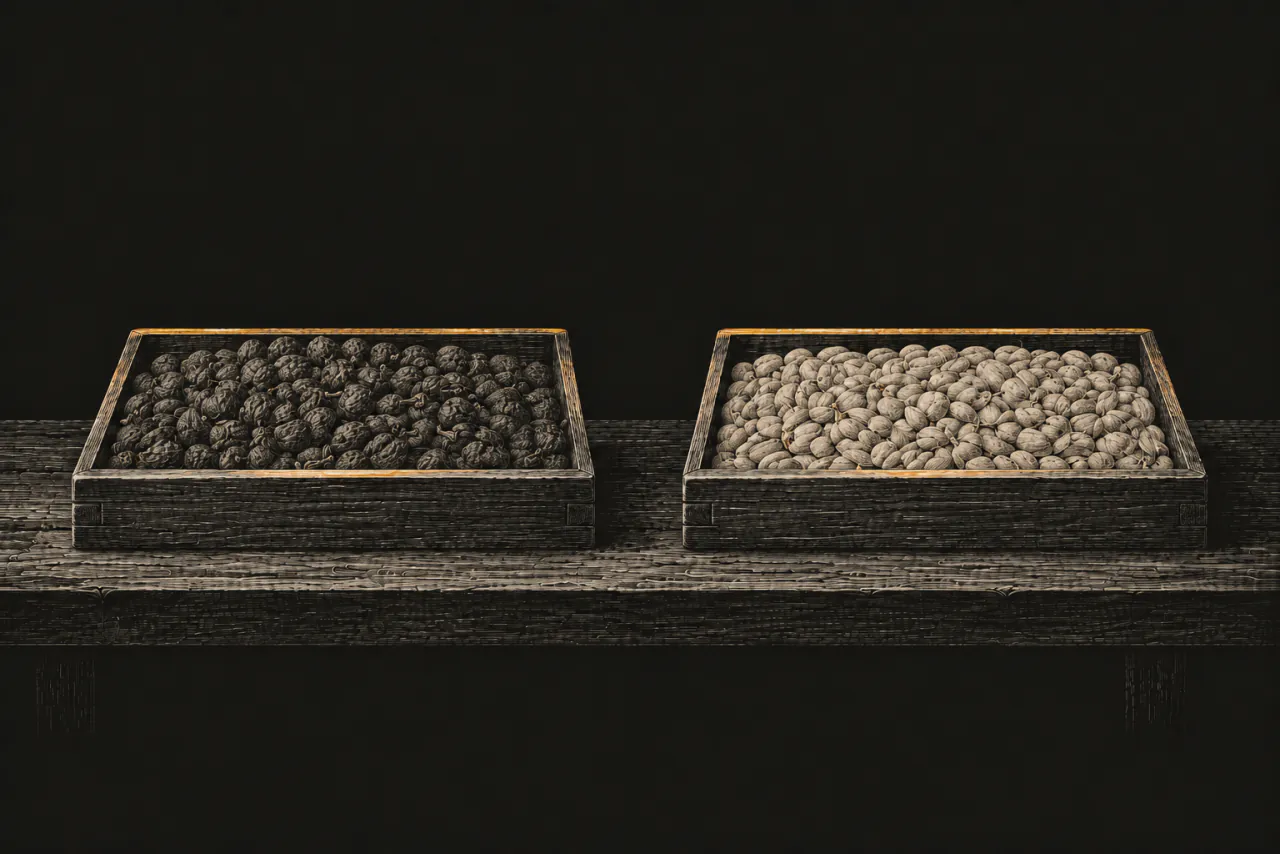 NATURALWASHED$803/LB$661/LB2018 BOP
Plate 5Figure 11.1
Two first places
Two first places from the same farm, one natural and one washed, each sold separately.
- GN-1
- Elida Geisha Green Tip Natural, natural, 100 lb, $803 a pound
- GW-1
- Elida Geisha Green Tip Washed, washed, 100 lb, $661 a pound
- Two lots and two prices, with no sale at $830 a pound
SourceBest of Panama Auction 2018 official results page; Lamastus Family Estates blog, 2018-06-04Cited source
SourceDaily Coffee News, Nick Brown, 2018-07-20; Best of Panama Auction 2018Cited source
2004PA101 Jaramillo Special
The Roasterie, inc; Public Market Coffee Co.; Groundwork Coffee Co.
- NAMES
- Several
2005pa052505-01 Hacienda La Esmeralda
Volcafe Specialty Coffee
- NAMES
- One
200601-CC2115 Hacienda la Esmeralda
Small Axe Coffee Alliance (Sweet Maria's Coffee Inc, Stumptown Coffee Roasters, Intelligentsia Coffee Roasters, Groundwork Coffee Company and Kaffa)
- NAMES
- Several
2007pa2007-01 Hacienda la Esmeralda
The Roasterie, inc.; Intelligentsia; Roastmasters.com (Willoughby's Coffee & Tea); Zoka Coffee Roaster; 49th Parallel Roasters; Groundwork Coffee Co.; Coffee Klatch Roasting
- NAMES
- Several
2008PA2008-06 Geisha Aristar Agrario La Valentina
Wataru for Gabee Yang
- NAMES
- One
2009PA09-01 Esmeralda Special
Wataru for Ogawa Coffee
- NAMES
- One
2010PA-01 Esmeralda Special (1217)
Saza Coffee
- NAMES
- One
- Saza
- On the list
2011PA-NAT-A Don Pachi Geisha
Wataru for BACH KAFFEE (Japan), SAZA COFFEE (Japan)
- NAMES
- Several
- Saza
- On the list
2012PA-N-01 Kotowa Don K Geisha Natural
Horiguchi Coffee & SAZA COFFEE (JAPAN)
- NAMES
- Several
- Saza
- On the list
2013PA-N-01 Esmeralda Special Natural C.V.
Saza Coffee (JAPAN); HAAYA GOURMET COFFEE CO., LTD (TAIWAN)
- NAMES
- Several
- Saza
- On the list
2014PA-GN-01 La Mula Natural CAC
Junior Coffee
- NAMES
- One
2015PA-EN-01 Esmeralda Geisha Natural Jaramillo
Saza Coffee & HAAYA GOURMET COFFEE CO., LTD.
- NAMES
- Several
- Saza
- On the list
2016PA-EW-01 Elida Geisha Green Tip Washed
Saza Coffee
- NAMES
- One
- Saza
- On the list
2017GN-01 Esmeralda Geisha Cañas Verdes Natural
KEW Specialty Coffee Ltd, Sydney Coffee Business Pty Ltd, SAZA COFFEE JAPAN
- NAMES
- Several
- Saza
- On the list
2018GN-1 ELIDA GEISHA GREEN TIP NATURAL
BLACK GOLD COFFEE CO. LTD & OKLAO INTERNATIONAL CO. LTD. & CHANG WEI SHIN Sourced for: SAZA COFFEE / KLATCH COFFEE/COFFEE TREASURES/SHUNDA FOOD FLAVOR & INGREDIENTS CO., LTD
- NAMES
- Several
- Saza
- On the list
2019GNEP-01 ELIDA GEISHA GREEN TIP NATURAL
SAZA COFFEE, Haaya Gourmet Coffee Ltd., Klatch Coffee USA, Black Gold Coffee Co. Ltd. (Taiwan), OKLAO Specialty Coffee, Grand Cru Coffee Ltd (China), Willoughby's Coffee & Tea, Aroma Coffee Australia, KEW SPECIALTY COFFEE for COFFEE TECH LTD(coffee-tech.co.nz), HWC ROASTERS FOOD AND BEVERAGE CO. LTD., The Hub Coffee Malaysia, Difference Coffee Co., Dragonfly Coffee Rosters
- NAMES
- Several
- Saza
- On the list
2020GW-01 FINCA SOPHIA OLYMPUS GEISHA LAVADO – C460
PICK COFFEE 立裴米緹 / 上海咖威Cooway&音季 / S.O.E Coffee / June’s Garden Coffee六月花园咖啡 / CMLab罗锦铭 / 致品山下 / Liming利茗精密減速機 / GK咖啡x平安居咖啡民宿 / TUMAZ Coffee黑熊咖啡 / SAZA COFFEE / BlackDrum Roasters / kafeD / Yi Zheng Coffee Roastery 昆山亿政 / C•T台北uSmile coffee北京易大 / Ningbo AncientCoffee宁波愛咖啡 /
- NAMES
- Several
- Saza
- On the list
2021GN-01 Nuguo Fermented
SAZA COFFEE Grand Cru Coffee (China) Dragonfly Coffee Roasters DIFFERENCE COFFEE Coffee-Tech.co.nz / BC Co. NZ HWC Roasters
- NAMES
- Several
- Saza
- On the list
2022GN-01 Guarumo Coffee Farm Black Jaguar Natural Limited
SAZA COFFEE ・Grand Cru Coffee(China) ・Coffee-Tech.co.nz / L'escargot d' or cosmetocafe ・ECOFARM COFFEE 意可坊咖啡 ・Black Gold Specialty Coffee / Oklao Specialty Coffee / The Espresso Lab ・杭州资董窝玺&董咖啡 ・HWC Coffee ・DIFFERENCE COFFEE ・Fisher coffee 啡舍, ・东方国际商业(集团)有限公司, ・珈露梦咖啡(carmo), ・Rondo Cafe, Proud Mary Coffee
- NAMES
- Several
- Saza
- On the list
2023GW-01 Carmen Geisha - Carmen Estates By Panama Red Carmen Café Trading
Coffee Tech Limited (NZ)/coffee-tech.co.nz ; SAZA COFFEE ; 格米莱GEMILAI /Corrima coffee machine ; CHG & MoveRiverCoffee.公子高.lzkngy ; Difference Coffee ; L'escargot d'or cosmetocafe, The Espresso Lab, Grand Cru Coffee (China), 叁生恬铺
- NAMES
- Several
- Saza
- On the list
2024GN-01 Elida Geisha Natural Vuelta
SAZA COFFEE, Grand Cru Coffee (China), OKLAO SPECIALTY COFFEE, BREW BOYY CREW, Ruber.Roastery(Korea), Pebble Coffee for Simple Kaffa, Paradise Coffee Roasters, E.C, 制糖师, 叁生恬铺杭州旺焙学院, 乜早, One by One Cafe (Tokyo & Taizhou), CHG手多多X Pincle拼一口咖啡
- NAMES
- Several
- Saza
- On the list
2025GW-01 Hacienda La Esmeralda Geisha Washed
Julith Coffee
- NAMES
- One
2026GW-01 Elida Geisha Torre
京东 JD.com
- NAMES
- One
SourceSCAP results graphics and pages, all years; Best of Panama auction platform · names counted by OLLA from the listsCited source
Section 12F12 ↑
12. Gesha at other auctions
Finding F12
The same name fetches prices an order of magnitude apart at a different auction. Panama's record is $30,204 a kilo, and the record at the source farm's own auction is $1,620.40.
Two private auctions in Panama
The earliest documented edition of Hacienda La Esmeralda's own auction is the “Esmeralda Special Auction” of 22 May 2008. An auction lot was then 300 pounds, and the top price in 2008 was $105.25 a pound. The results pages for 2008 to 2011 do not give the variety.
From 2022 it switched to pricing per kilo, with most lots at 10 kg. The top price was $7,532 a kilo in 2024 and $14,964 a kilo in 2025, though that lot was only 0.8 kg. In 2026 it was $10,253 a kilo, for a 10 kg lot.
Lamastus Family Estates also held a private auction on 9 September 2026. The top lot was Luito Geisha Washed L1, at $14,710 a kilo, and it was only 2 kg.
The auction at the source, Pride of Gesha
Gesha Village's auction was called the Gesha Village Coffee Auction in 2017 and 2018 and has been Pride of Gesha since 2019, and by 2026 it had been held ten times. The top price rose from $85.10 a pound in 2017 to $735 a pound in 2026, or $1,620.40 a kilo. The 2026 lot was GVA.RSV.5, of the Gesha 1931 line, washed and dried in a dark room.
It was only 19.84 pounds, or 9 kg, whereas the top lots of earlier editions were all between 132 and 198 pounds. The price went up and the lot got smaller, and anyone citing this record should say both.
A trade publication said in 2022 that Pride of Gesha's $254 a pound that year was the highest price in the history of African coffee. That is no longer true. In 2025 and 2026, Ethiopian lots that were not Gesha sold for $1,604 to $2,376.50 a kilo. The two highest Ethiopian auction prices we saw in 2026 were ALO's $2,275 a kilo and Faysel Abdosh's $2,376.50 a kilo, and neither lot was Gesha.
Cup of Excellence
The Cup of Excellence (CoE) is a competition and auction held separately in each producing country and run by the Alliance for Coffee Excellence (ACE). For the years that can be found on the ACE website, the highest CoE price in seven countries, Guatemala, Costa Rica, Brazil, Nicaragua, Honduras, Colombia and El Salvador, was set by a Gesha lot.
Ecuador's top price was for the variety Sydra. For Mexico and Peru, the page for the year of the top price has no variety column, so we cannot tell.
The highest we saw was El Injerto I's natural Gesha in Guatemala in 2026. Split lot 1C sold for $449.10 a pound, or $990.10 a kilo, and weighed only 33.1 pounds. The other two lots of the same coffee, 219.3 pounds each, sold for only $161.30 and $161.10 a pound.
For years with a single national ranking, we counted the lots containing Gesha in the CoE top ten. Guatemala 2023 and Peru 2023 each had 10, Peru 2024 had 9, Costa Rica 2023 had 8, Colombia 2023 and Honduras 2024 each had 7, and Nicaragua 2024 had 3.
Lots whose variety column lists a mix that includes Geisha are counted too. From 2025 several countries switched to grouping lots by processing method, so the top ten was no longer one ranking and we stopped counting.
$30,204 is still the highest
As of 26 September 2026, within the scope of our search, we found no coffee sale on public record above $30,204 a kilo. The search covered the auction platform pages of Best of Panama, Esmeralda, Lamastus, Pride of Gesha, ALO and Faysel Abdosh, 197 CoE results pages across 11 countries, the main trade media, and searches in Chinese, English and Japanese. Private negotiations whose results are not published, and platforms inside China, were outside that scope.
- Best of Panama top Gesha
- Esmeralda private auction
- Pride of Gesha
- Years the Esmeralda results page gives no variety
USD/kg · log scale
Best of Panama top Gesha / Esmeralda private auction / Pride of Gesha · 2004–2026 · USD/kg · log scale. The values are in the data table below the chart.
Figure data · USD/kg
| Best of Panama top Gesha | Esmeralda private auction | Pride of Gesha | |
|---|---|---|---|
| 2004 | 46.30 · 420 kg lot | ||
| 2005 | 44.31 · 480.01 kg lot | ||
| 2006 | 110.78 · 300.01 kg lot | ||
| 2007 | 286.60 · 226.8 kg lot | ||
| 2008 | 48.50 · 181.44 kg lot | 232.04 · 136.08 kg lot | |
| 2009 | 157.63 · 158.76 kg lot | 259.04 · 136.08 kg lot | |
| 2010 | 375.23 · 181.44 kg lot | 80.47 · 136.08 kg lot | |
| 2011 | 245.82 · 45.36 kg lot | 117.95 · 136.08 kg lot | |
| 2012 | 205.58 · 45.36 kg lot | 145.51 · 136.08 kg lot | |
| 2013 | 772.17 · 45.36 kg lot | 281.09 · 45.36 kg lot | |
| 2014 | 237.79 · 45.36 kg lot | 232.59 · 136.08 kg lot | |
| 2015 | 308.87 · 45.36 kg lot | 289.91 · 136.08 kg lot | |
| 2016 | 607.37 · 45.36 kg lot | 297.62 · 136.08 kg lot | |
| 2017 | 1,324.98 · 45.36 kg lot | 401.24 · 136.08 kg lot | 187.61 · 90 kg lot |
| 2018 | 1,770.31 · 45.36 kg lot | 749.57 · 22.68 kg lot | 231.49 · 90 kg lot |
| 2019 | 2,268.56 · 45.36 kg lot | 359.35 · 68.04 kg lot | 263.45 · 60 kg lot |
| 2020 | 2,867.11 · 45.36 kg lot | 399.04 · 22.68 kg lot | 182.43 · 60 kg lot |
| 2021 | 5,661.47 · 45.36 kg lot | 758.39 · 22.68 kg lot | 198.97 · 60 kg lot |
| 2022 | 4,410.33 · 45.36 kg lot | 2,755 · 10 kg lot | 559.97 · 60 kg lot |
| 2023 | 10,005 · 25 kg lot | 2,504 · 10 kg lot | 498.47 · 60 kg lot |
| 2024 | 10,013 · 20 kg lot | 7,532 · 10 kg lot | 356.60 · 60 kg lot |
| 2025 | 30,204 · 20 kg lot | 14,964 · 0.8 kg lot | 992.08 · 30 kg lot |
| 2026 | 18,004 · 15 kg lot | 10,253 · 10 kg lot | 1,620.40 · 9 kg lot |
SourceBest of Panama as in chapter 08; Hacienda La Esmeralda auction results pages 2008–2026; Pride of Gesha and Gesha Village auction results pages 2017–2026 · per-kilo prices converted from per-pound pricesCited source
| COUNTRY | YEAR | GESHA? | USD/lb |
|---|---|---|---|
| Guatemala | 2026 | Yes, split lot 1C, 33.1 lb | 449.10 |
| Costa Rica | 2018 | Yes | 300.09 |
| Brazil | 2018 | Yes | 143.00 |
| Nicaragua | 2026 | Yes | 140.00 |
| Honduras | 2024 | Yes | 136.50 |
| Colombia | 2021 | Yes | 135.10 |
| El Salvador | 2024 | Yes | 122.00 |
| Ecuador | 2022 | No, Sydra | 105.10 |
| Mexico | 2017 | No variety column on the page | 100.49 |
| Peru | 2017 | No variety column on the page | 100.10 |
SourceAlliance for Coffee Excellence country results pages; Tico Times 2026-07-11; Prensa Libre 2026-07-27Cited source
- Guatemala 202310/10
- Peru 202310/10
- Peru 20249/10
- Costa Rica 20238/10
- Colombia 20237/10
- Honduras 20247/10
- Nicaragua 20243/10
Figure data
| Item | Value | Rank |
|---|---|---|
| Guatemala 2023 | 10 | 10/10 |
| Peru 2023 | 10 | 10/10 |
| Peru 2024 | 9 | 9/10 |
| Costa Rica 2023 | 8 | 8/10 |
| Colombia 2023 | 7 | 7/10 |
| Honduras 2024 | 7 | 7/10 |
| Nicaragua 2024 | 3 | 3/10 |
SourceAlliance for Coffee Excellence results pages · counts by OLLACited source
Section 13F13 ↑
13. What an auction measures, and the layers in the price
Finding F13
An auction price shows scarcity and how fierce the bidding was; on its own it cannot prove quality in the cup. The high price is six things stacked together, and only one of them can be checked on the cupping table.
What a multiple says
On 7 August 2025, Best of Panama's GW-01 sold for $30,204 a kilo. The lot was 20 kg, scored 98 points, drew 549 bids and sold for $604,080 in all, and the winner was Julith Coffee.
The commodity coffee price means the reference price on the futures market. Fresh Cup's report quoted a commodity price of $2.98 a pound for the same day, about $6.57 a kilo. The two prices are about 4,597 times apart.
A price 4,597 times higher does not make the coffee 4,597 times better. The price was bid up by buyers from many countries on a lot of only 20 kg, and it contains scarcity, publicity value and the buyers' own marketing budgets.
The two prices were never the same kind of thing. One is the sale price of a small lot at auction, the other a reference price on the futures market. Reading the gap as a scale of quality mistakes an auction for a cupping. That is our judgement.
A different yardstick
The same record price is 18.64 times the highest-priced Gesha we saw in Ethiopia, a 9 kg lot at Pride of Gesha in 2026 that sold for $1,620.40 a kilo. Both are the top prices at their own auctions, so the comparison shows where each stands at its own auction, not absolute quality across auctions.
Six layers of price
Why it costs so much cannot be answered with one number, because the price is not one cost but six premiums of different kinds stacked together. From the bottom up they are farming cost, selection cost, cup quality, identity assets, institutional endorsement, and publicity and collecting.
Identity assets are what the name and the provenance are worth in themselves, and institutional endorsement is the credibility that competitions and auctions confer. The lower three layers are facts of farming and quality control, the upper three are market and story, and the higher you go the harder they are to verify. The only layer that can be checked by blind tasting on the cupping table is cup quality.
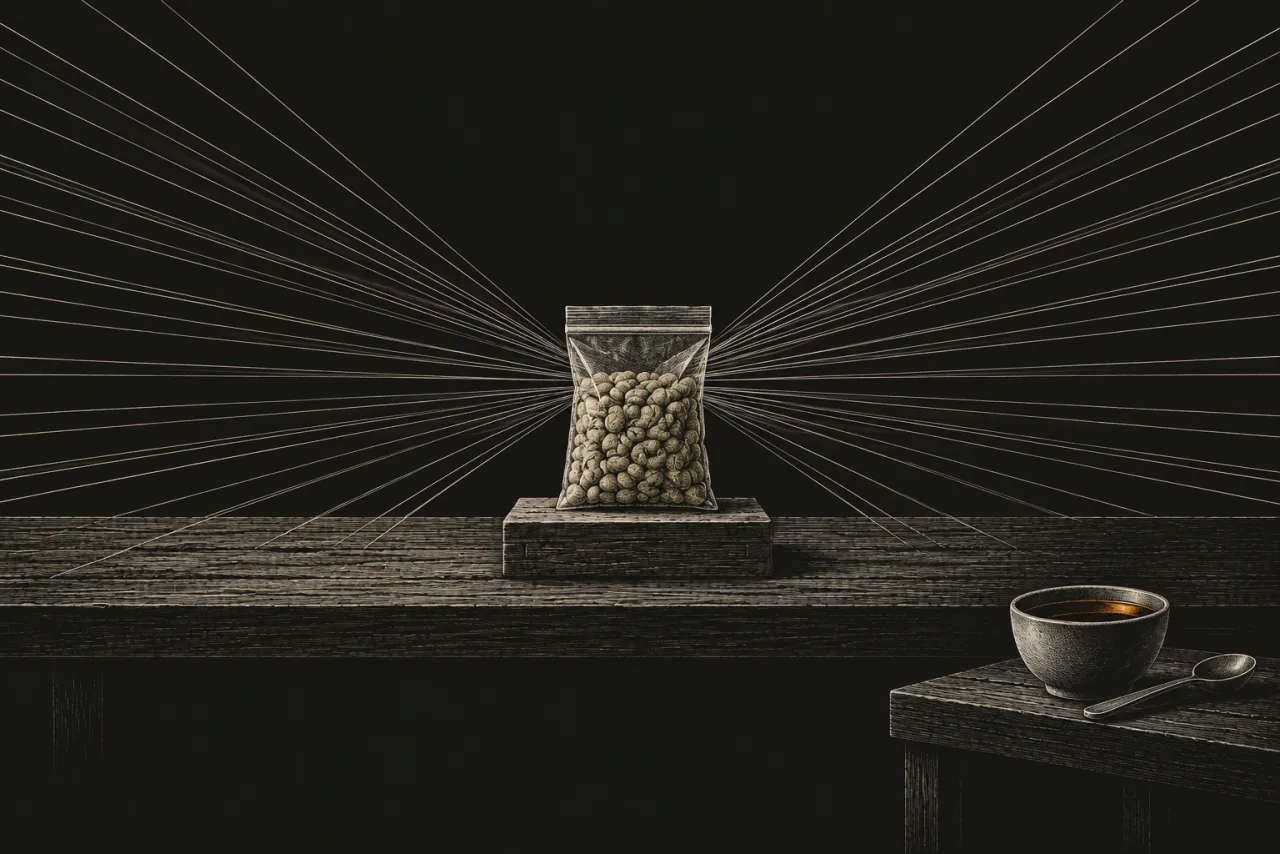 20 KG
20 KGPlate 6Figure 13.1
What the auction room measures
The bidding happens inside the room; the cup is drawn outside it.
- INSIDE
- The price is set by bidding
- OUTSIDE
- Quality in the cup needs blind tasting, and bidding cannot prove it
SourceOLLA editorial framework · the 20 kg is from the 2025 GW-01 results pageEditorial
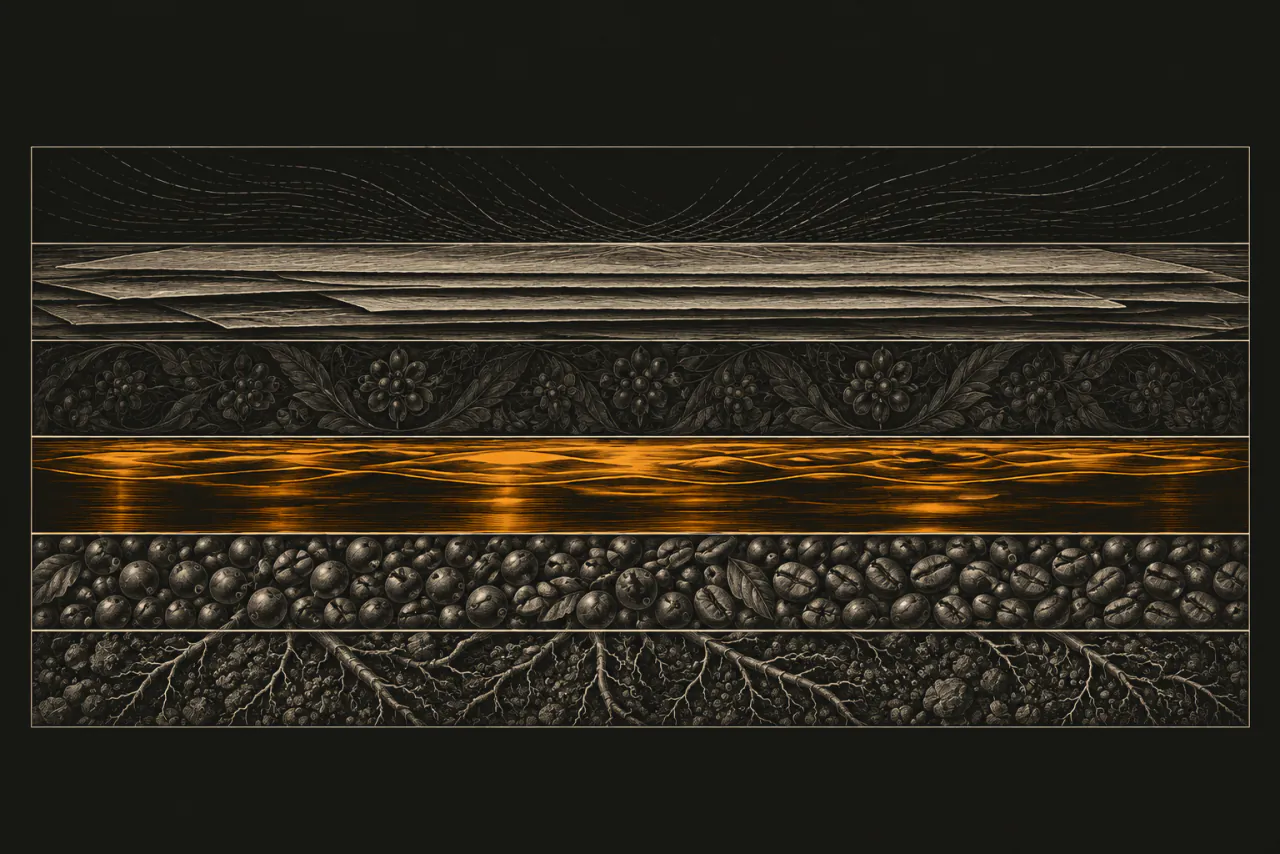
Plate 7Figure 13.2
Six layers of price
The lower three layers are facts of farming and quality control, the upper three are market and story, and the higher the layer the harder it is to verify. The six are drawn the same thickness, which says nothing about how much of the price each accounts for.
- BOTTOM UP
- Farming cost, selection cost, cup quality, identity assets, institutional endorsement, publicity and collecting
- Amber marks cup quality, the only layer that can be checked on the cupping table
SourceOLLA editorial framework, not an industry standard; there is no public pricing by layerEditorial
SourceBest of Panama auction platform 2025; Fresh Cup 2025-08-12; Pride of Gesha 2026 results page · multiples calculated by OLLACited source
Section 14F14 ↑
14. From the kilo to the cup
Finding F14
At 15 g of roasted coffee per cup and 15% weight loss in roasting, the green coffee alone in the 2025 record lot costs $533.01 a cup at the auction price. For the 2026 median lot it is $53.28.
How it is worked out
Every number in this chapter is our own calculation, not one a source gives. If a cup uses 15 g of roasted coffee and roasting loses 15% of the weight, the green coffee needed for a cup is 15 divided by 0.85, about 17.6471 g.
The auction cost of the green coffee in a cup is the price per kilo multiplied by 17.6471 and divided by 1,000, the same method as in OLLA LAB's Best of Panama 2026 issue. On these assumptions, the green coffee in a cup of the year's top Gesha cost $0.82 in 2004, $5.06 in 2007, $13.63 in 2013, $23.38 in 2017, $99.91 in 2021, $176.56 in 2023, $533.01 in 2025 and $317.72 in 2026.
In the 2026 Gesha category, the median lot comes to $53.28 a cup and the cheapest lot to $26.54. In 2025 the median lot was $20.59 and the cheapest $11.89. By the same method, the commodity price on 7 August 2025 comes to about $0.12 of green coffee per cup.
The grams per cup and the weight loss are our own choices, and with other assumptions the results change in proportion. These numbers stop at the auctioned green coffee. Freight, insurance, duties, the labour of roasting and packing, and a shop's costs and profit have no public data and are not included.
One retail price
On 26 September 2026 Julith Coffee, the winner of GW-01 in 2025, was selling a 15 g pack of “Best of Panama Nido 7 – Hacienda La Esmeralda” in its online shop at 3,600.00 dirhams, marked as an auction lot. At the UAE central bank's pegged rate that is about $980, roughly 1.8 times the auction cost of the green coffee per cup by the same method.
The product page carries no lot number, and matching it to the 2025 GW-01 is our judgement. The multiple describes only the gap in price; there is no public data on how much of it is freight, tax, roasting and profit. For the 2026 lots we have not yet found a retail page from any buyer.
Choose a lot
2025 · Top price · GW-01 Hacienda La Esmeralda Geisha Washed
Auction price, green coffee
USD 30,204 / kg
Green coffee per cup
17.6471 g
15 g ÷ (1 − 15%)
Auction cost of green coffee per cup
Cost per cup = price per kg × grams roasted ÷ (1 − weight loss) ÷ 1,000
Roasted coffee per cupAssumption
15 g10–20 g
Roast weight lossAssumption
15%12–20%
Only the auction price of the green coffee is counted. Freight, insurance, duties, roasting, packing, shop costs and profit are not included. The two assumptions are set by OLLA and are not an industry standard.
SourceSale prices as in chapters 08 and 09 · cost per cup estimated by OLLACited source
- The year's top-priced lot
- Median lot
- Lowest lot
- Julith retail, 15 g pack
USD/cup · log scale
- a 2025 · Retail price; matching it to a lot is an editorial judgement
The year's top-priced lot / Median lot / Lowest lot / Julith retail, 15 g pack · 2004–2026 · USD/cup · log scale. The values are in the data table below the chart.
Figure data · USD/cup
| The year's top-priced lot | Median lot | Lowest lot | Julith retail, 15 g pack | |
|---|---|---|---|---|
| 2004 | 0.82 | |||
| 2005 | 0.78 | |||
| 2006 | 1.95 | |||
| 2007 | 5.06 | |||
| 2008 | 0.86 | |||
| 2009 | 2.78 | |||
| 2010 | 6.62 | |||
| 2011 | 4.34 | |||
| 2012 | 3.63 | |||
| 2013 | 13.63 | |||
| 2014 | 4.20 | |||
| 2015 | 5.45 | |||
| 2016 | 10.72 | |||
| 2017 | 23.38 | |||
| 2018 | 31.24 | |||
| 2019 | 40.03 | |||
| 2020 | 50.60 | |||
| 2021 | 99.91 | |||
| 2022 | 77.83 | |||
| 2023 | 176.56 | 11.84 | 6.56 | |
| 2024 | 176.70 | 17.79 | 9.30 | |
| 2025 | 533.01 | 20.59 | 11.89 | 980 · Listed at 3,600.00 dirhams |
| 2026 | 317.72 | 53.28 | 26.54 |
SourceSale prices as in chapters 08 and 09; Julith Coffee product page; UAE central bank exchange-rate page · cost per cup estimated by OLLACited source
Section 15F15 ↑
15. Common misreadings
Finding F15
Floral does not mean Gesha, heavy fermentation does not mean complexity, a record price is not the year's market, and “Gesha” on the bag does not mean T2722.
This chapter does not argue anything afresh. It puts a few common claims next to the evidence that corrects them, and each points back to the chapter where it is set out in full. The first two are our judgement, since no source has given a standard answer, and the rest have data behind them.
“If it's floral, it's Gesha.” Floral is a descriptor that many Ethiopian-derived materials and many processing methods can bring out. What makes Gesha recognisable is whether the aroma and the structure in the mouth hold each other up, not any single descriptor. That is our judgement.
“The heavier the fermentation, the more complex the coffee.” Heavy fermentation covers up what the variety itself expresses, and the heavier the processing, the harder it is to tell what variety lies underneath. That too is our judgement.
“The record price is the year's market.” The top price in 2026 was 40.39% below 2025's, while the median was 2.59 times 2025's. The 2026 top lot accounted for only 8.88% of the auction's sales. See chapters 08 and 09.
“If the bag says Gesha, it's T2722.” Of 88 samples held as Gesha, only 39% matched the reference plant exactly. In a 2026 case in Ecuador, “Gesha” seed tested as a different Ethiopian landrace. See chapters 02 and 06.
“It went into CATIE in 1953.” CATIE was not founded until 1973. In 1953 the material was received by IICA's introduction garden at Turrialba, a collection that CATIE looks after today. See chapter 03.
“It was introduced to Panama for leaf rust resistance.” Leaf rust was first reported in the Americas only in 1970, and the claim that it tolerated rust rests on tests in a germplasm garden. What Esmeralda remembers is its resistance to ojo de gallo. See chapter 03.
“ALO's $1,739 a kilo is the top price for Ethiopian Gesha.” That lot's variety was 74158, not Gesha. The highest price for Ethiopian Gesha that we have seen is Pride of Gesha's $1,620.40 a kilo in 2026. See chapters 12 and 13.
How to tell: four axes
Rather than counting how many aroma words a cup hits, we suggest breaking “it smells good” into four axes and noting each separately: aroma intensity, the shape of the acidity, the structure in the mouth and the length of the finish. Then see whether the four point the same way.
To use it, taste blind first and write one sentence for each axis. Only then look at the label, and see which impressions hold up and which were only expectation. After that, change one variable and compare again, such as the same farm with a different processing method, or the same beans at a different roast level.
 FLORALFERMENTPRICE
Plate 8Figure 15.1
Three surface signals
Amber marks the side that is easily taken for the answer, not the answer itself.
SourceOLLA editorial judgementEditorial
SourceSources for each row are in the chapter it points to · the first two rows are OLLA's editorial judgementEditorial
Plate 9Figure 15.3
Four axes
Note the four axes separately, then see whether they point the same way.
- FOUR
- Aroma intensity, shape of the acidity, structure in the mouth, length of the finish
- USE
- Taste blind first and write one sentence for each. Then read the label, then change one variable and compare
- Amber: the four agree
- Light dashed line: the four contradict each other
SourceOLLA editorial framework, not an SCA or CVA standardEditorial
Section 16F16 ↑
16. What to ask before buying
Finding F16
First see how much it can account for, then look at the price. A Gesha that cannot tell its own history has no grounds for being expensive.
This chapter is our advice, not something a source says. After each question we note which chapter it draws on.
Ask about the line first, whether it is the T2722 line, material from the source forest, or material that some place introduced on its own (chapters 02 and 05). Then ask about provenance, whether the seller can say how it was introduced rather than offering only the one word “Gesha” (chapters 03 and 07).
Then ask about the lot, whether it is a regular lot or an auction lot, since the two are expensive for different reasons. An auction lot should match a lot number and a winning bidder. Even the 15 g pack sold by the winner of the 2025 record lot has no lot number on its product page (chapters 11 and 14).
Then ask about processing, and whether it is heavy enough to cover up the variety (chapter 15). The last question is new in this edition. It asks whether there has been a DNA comparison, or at least a source for the introduction that can be checked. The farm in Ecuador that paid $500 a kilo for “Gesha” seed found out it was different material only after testing (chapter 06).
Ordinary buyers cannot get hold of DNA reports, and that is the reality. So the practical form of the fifth question is to ask the seller where the seed or seedlings came from, and who can vouch for it.
SourceOLLA editorial judgementEditorial
Plate 10Figure 16.2
A provenance passport
The five blanks match the five questions below. There is no official Gesha passport, and this is only a metaphor.
- FIVE
- Line, provenance, lot, processing and testing, matching the five questions below one for one
SourceOLLA editorial judgementEditorial
- LINE
- Is it the T2722 line, material from the source forest, or something introduced locally?
- PROVENANCE
- Can the seller explain how it was introduced, or is there only the word “Gesha”?
- LOT
- A regular lot or an auction lot? If it is an auction lot, do the lot number and the winner match?
- PROCESSING
- Is the processing heavy enough to cover up the variety?
- TESTING
- Has there been a DNA comparison? At the least, where did the seed or seedlings come from, and who can vouch for it?
SourceOLLA editorial judgement, based on chapters 02, 03, 06, 11 and 14Editorial
Materials and sources
The dossier's own source list, as written.
- [01]Specialty Coffee Association of Panama · Marcelino Rosario · Lamastus Lérida y Altieri lideran el Best of Panama; Hacienda La Esmeralda conquista la Copa Panamá · 2026-08-03archived copy
- [02]Specialty Coffee Association of Panama · Marcelino Rosario · Subasta mundial de los mejores cafés de Panamá · 2026-09-22archived copy
- [03]Specialty Coffee Association of Panama · Best of Panama Auction 2001-2017archived copy
- [04]Best of Panama / SCAP · Best of Panama Auction 2021archived copy
- [05]Best of Panama / SCAP · Best of Panama Auction 2022archived copy
- [06]Best of Panama / SCAP · Best of Panama Auction 2023archived copy
- [07]Hacienda La Esmeraldaarchived copy
- [08]Specialty Coffee Association of Panama · LAMASTUS FAMILY ESTATESarchived copy
- [09]Specialty Coffee Association of Panama · HACIENDA LA ESMERALDAarchived copy
- [10]Specialty Coffee Association of Panama · CAFE GALLARDOarchived copy
- [11]Specialty Coffee Association of Panama · Best of Panama 2017archived copy
- [12]Lamastus Family Estates · Best of Panama 2018 · 2018-06-04archived copy
- [13]Best of Panama / SCAP · Best of Panama Auction 2018archived copy
- [14]Lamastus Family Estates · Best of Panama 2019 · 2019-06-04archived copy
- [15]Best of Panama / SCAP · Best of Panama Auction 2019archived copy
- [16]Specialty Coffee Association of Panama · 2020archived copy
- [17]Best of Panama / SCAP · Best of Panama Auction 2020archived copy
- [18]Specialty Coffee Association of Panama · 2021archived copy
- [19]Specialty Coffee Association of Panama · 2023archived copy
- [20]Specialty Coffee Association of Panama · 2024archived copy
- [21]Specialty Coffee Association of Panama · Hacienda La Esmeralda arrasó en el BOP 2025 · 2025-06-08archived copy
- [22]Specialty Coffee Association of Panama · Café Geisha de Panamá sacude al mundo con impresionantes récords mundiales · 2025-08-07archived copy
- [23]Specialty Coffee Association of Panama · Best of Panama 2004 - Final Results · 2004-07-03archived copy
- [24]Specialty Coffee Association of Panama · Best of Panama 2005 - Final Resultsarchived copy
- [25]Specialty Coffee Association of Panama · Best of Panama 2006 - Final Results · 2006-05-30archived copy
- [26]Specialty Coffee Association of Panama · Best of Panama 2007 - Final Results · 2007-05-29archived copy
- [27]Specialty Coffee Association of Panama · Best of Panama 2008 - Final Results · 2008-05-20archived copy
- [28]Specialty Coffee Association of Panama · Best of Panama 2009 - Final Results · 2009-05-28archived copy
- [29]Specialty Coffee Association of Panama · Best of Panama 2010 - Final Results · 2010-05-25archived copy
- [30]Specialty Coffee Association of Panama · Best of Panama 2011 - Final Results · 2011-05-24archived copy
- [31]Specialty Coffee Association of Panama · Best of Panama 2012 - Final Results · 2012-05-22archived copy
- [32]Specialty Coffee Association of Panama · Best of Panama 2013 - Final Results · 2013-07-03archived copy
- [33]Specialty Coffee Association of Panama · Best of Panama 2014 - Final Results · 2014-06-24archived copy
- [34]Specialty Coffee Association of Panama · Best of Panama 2015 - Final Results · 2015-06-23archived copy
- [35]Specialty Coffee Association of Panama · Best of Panama 2016 Coffee Auction Results · 2016-06-30archived copy
- [36]Associated Press / MyPlainview · Café especial panameño logra precio récord en subasta · 2005-05-24archived copy
- [37]Panamá América · José Vásquez · Precio de geisha panameño logra nueva marca mundial · 2013-07-03archived copy
- [38]La Prensa · Geisha panameño se cotiza en Taiwan · 2014-06-24archived copy
- [39]La Estrella de Panamá · Mileika Lasso · Venden libra de café ‘gourmet’ a $275.50 · 2016-07-05archived copy
- [40]Best of Panama / M-Cultivo · Best of Panama Auction 2026 - Timeless Resonance · 2026-09-24archived copy
- [41]Best of Panama / M-Cultivo · Best of Panama 2025 Auction: Canvas of Terroir · 2025-08-07archived copy
- [42]Best of Panama / M-Cultivo · Best of Panama Auction 2024 (results table)archived copy
- [43]Julith Coffee · Best of Panama Nido 7 - Hacienda La Esmeraldaarchived copy
- [44]Central Bank of the UAE · Domestic Market Operationsarchived copy
- [45]Hacienda La Esmeralda · Our Storyarchived copy
- [46]Roastmasters.com (Home Coffee Roasting Blog) · La Esmeralda Sets New Record - $130 pound · 2007-05-29archived copy
- [47]Cafe Granja La Esperanza · Historyarchived copy
- [48]Hacienda La Esmeralda · Home Pagearchived copy
- [49]Revista Cafeicultura · Establece cafe de Panama nueva marca mundial en subasta por internet · 2010-05-25archived copy
- [50]Daily Coffee News · Nick Brown · Natural Geisha Breaks Best of Panama Auction Record at $803 Per Pound · 2018-07-20archived copy
- [51]Fresh Cup · Fionn Pooler · Record-Breaking Panama Gesha Price Stirs Praise and Criticism at Auction · 2025-08-12archived copy
- [52]World Coffee Research · Geisha (Panama) — variety catalogue entryarchived copy
- [53]Hacienda La Esmeralda · Our Storyarchived copy
- [54]Gesha Village Coffee Estate · The Villagearchived copy
- [55]Gesha Village Coffee Estate · Adam Overton; Rachel Samuel; Willem Boot · Our Storyarchived copy
- [56]Barista Magazine Online · Chris Ryan · Gesha Village Brings Ethiopia-Grown Gesha to the World · 2017-05-16archived copy
- [57]Roast Magazine (reprint hosted by Boot Coffee / coffeecourses.com) · Willem Boot · Variety is the Spice of Coffee: Geisha and Other Varietals (article reprint) · 2006-05-01archived copy
- [58]CATIE (Revista Forum Cafe, Sept 2020) · Centro Agronomico Tropical de Investigacion y Ensenanza (CATIE) · El Geisha se consolida entre las variedades mas exitosas en la taza de la excelencia · 2020-09-01
- [59]Revista Mexicana de Ciencias Agricolas 15(7) e3403 (INIFAP), doi:10.29312/remexca.v15i7.3403 · Silva Rincon C.I.; Alarcon Gutierrez E.; Garcia Perez J.A.; Sanchez-Velasquez L.R.; Iglesias Andreu L.G. · La variedad de cafe Geisha y su estatus en el mundo y en Mexico · 2024-12-12archived copy
- [60]Ramirez Caficultura desde Costa Rica · Jorge Ramirez Rojas · Variedad Geisha y evaluacion agronomica realizada en Costa Rica (Ramirez Caficultura desde Costa Rica No. 8) · 2014-11-01archived copy
- [61]Finca Deborah · Geisha Coffee · 2014-07-01archived copy
- [62]The Tropics Foundation · CATIE's Coffee Germplasm Collectionarchived copy
- [63]Cafe Granja La Esperanza · Historyarchived copy
- [64]Perfect Daily Grind · Yudi Guo · Panama, Colombia, Ethiopia: There is no best origin for Gesha coffee · 2024-01-15archived copy
- [65]Anacafe (Asociacion Nacional del Cafe, Guatemala) · Rafael Alberto Velasquez Orozco (PDF metadata) · Guia de variedades de cafe (2020) · 2020-03-06archived copy
- [66]Intelligentsia Coffee · Single Origin | Bolivia Finca Takesi Geisha · 2024-06-12archived copy
- [67]Melbourne Coffee Merchants · Las Alasitas Gesha Washed · 2020-12-04archived copy
- [68]Hacienda La Esmeralda · Jaramillo Farm · 2021-12-14archived copy
- [69]Daily Coffee News by Roast Magazine · Ever Meister · Is it Geisha or Gesha? If Anything, It's Complicated · 2017-11-09archived copy
- [70]bioRxiv, doi:10.1101/2024.06.21.600137 · Medrano J.F.; Cantu D.; Minio A.; et al. · De novo whole-genome assembly and annotation of a high-quality coffee variety from the primary origin of coffee, Coffea arabica var. Geisha (preprint) · 2024-06-27archived copy
- [71]G3 Genes|Genomes|Genetics 15(1) jkae262, doi:10.1093/g3journal/jkae262 · Medrano J.F.; et al. · De novo whole-genome assembly and annotation of Coffea arabica var. Geisha, a high-quality coffee variety from the primary origin of coffee · 2025-01-01
- [72]Monarch Coffee (Hawaii) · The Migration of Gesha Coffee into Hawaiiarchived copy
- [73]Doi Chaang Coffee · Doichaang Geicha Coffee · 2017-08-16archived copy
- [74]保山市人民政府门户网站(发布机构:保山市投资促进局;转载来源:保山日报) · 瑰夏,保山小粒咖啡家族的“新秀” · 2024-01-08archived copy
- [75]云南网(保山日报) · 刁丽俊 · 瑰夏,保山小粒咖啡家族的“新秀” · 2024-01-08archived copy
- [76]VERSE · 冠軍咖啡農曾福森:在阿里山種出超越巴拿馬的藝伎咖啡 · 2023-09-06archived copy
- [77]Revista Espresso · Equipe Espresso · Provamos 6 cafes exoticos do banco de germoplasma do IAC · 2024-10-22archived copy
- [78]Imani Development / Coffee Association of Malawi (TraCSS project) · Handbook for Sustainable Coffee Production in Malawiarchived copyThe original page is only available at an http address; please use the archived link.
- [79]World Coffee Research · Mzuzu variety trial moves forward with first harvest · 2022-07-12archived copy
- [80]Selva Negra (Nicaragua) · Historyarchived copy
- [81]elsalvador.com (El Diario de Hoy) · De donde viene el Geisha, el mejor cafe de El Salvador? · 2018-05-03archived copy
- [82]Tim Wendelboe · Finca el Puentearchived copy
- [83]Onyx Coffee Lab · Colombia Cafe Granja Geshaarchived copy
- [84]The Coffee Collective · Bolivia 2016 Part 2 Takesi · 2019-05-14archived copy
- [85]Finca El Puente (Honduras) · Our Storyarchived copy
- [86]Agricafe (Bolivia) · Agricafe brochurearchived copy
- [87]World Coffee Research Varieties Catalog · World Coffee Research · Geisha (Panama)archived copy
- [88]World Coffee Research · Study: Widespread lack of genetic conformity for arabica coffee · 2020-03-23archived copy
- [89]Journal of AOAC International 103(2):325-334 (PDF via CIRAD Agritrop) · Pruvot-Woehl S; Krishnan S; Solano W; Schilling T; Toniutti L; Bertrand B; Montagnon C · Authentication of Coffea arabica Varieties through DNA Fingerprinting and its Significance for the Coffee Sector · 2020
- [90]Nature Genetics 56(4):721-731 (PMC11018527) · Salojarvi J et al. (last: Descombes P) · The genome and population genomics of allopolyploid Coffea arabica reveal the diversification history of modern coffee cultivars · 2024-04-15archived copy
- [91]G3 Genes|Genomes|Genetics 15(1):jkae262 (PMC11708220) · Medrano JF; Cantu D; Minio A; ...; Hulse-Kemp AM · De novo whole-genome assembly and annotation of Coffea arabica var. Geisha, a high-quality coffee variety from the primary origin of coffee · 2024-11-15archived copy
- [92]Nature Communications 15:463 (PMC10805892) · Scalabrin S; Magris G; Liva M; ...; Morgante M · A chromosome-scale assembly reveals chromosomal aberrations and exchanges generating genetic diversity in Coffea arabica germplasm · 2024-01-23archived copy
- [93]Frontiers in Plant Science 17 · Tapia-Armijos MF; Gusman-Montalvan E; Velez-Mora DP; Iniguez-Armijos C · What you plant may not be what you bought: morphological and genetic discordance in specialty Coffea arabica L. cultivars from Ecuador · 2026-07-14archived copy
- [94]Revista Mexicana de Ciencias Agricolas 15(7):e3403 · Silva Rincon CI; Alarcon Gutierrez E; Garcia Perez JA; Sanchez-Velasquez LR; Iglesias Andreu LG · The Geisha coffee variety and its status in the world and in Mexico · 2024archived copy
- [95]Molecular Plant Pathology 18(8):1039-1051 (PMC6638270) · Talhinhas P; Batista D; Diniz I; ...; Silva MDC · The coffee leaf rust pathogen Hemileia vastatrix: one and a half centuries around the tropics · 2017archived copy
- [96]CATIE · CATIE: 50 anos contribuyendo al desarrollo de Turrialba · 2023-03-21archived copy
- [97]CATIE · Seminario tecnico celebra 75 anos de la Coleccion Internacional de Cafe en el CATIE · 2024-10-08archived copy
- [98]Ramirez Caficultura desde Costa Rica (newsletter) · Jorge Ramirez Rojas · Variedad Geisha y evaluacion agronomica realizada en Costa Rica (Ramirez Caficultura desde Costa Rica No. 8) · 2014-11archived copy
- [99]Hacienda La Esmeralda · Our Storyarchived copy
- [100]Gesha Village Coffee Estate · Gesha Village · The Villagearchived copy
- [101]Gesha Village Coffee Estate · Adam Overton; Rachel Samuel; Willem Boot · Our Storyarchived copy
- [102]Gesha Village Coffee Estate · Gesha Village · Gesha Village (home page)archived copy
- [103]Daily Coffee News by Roast Magazine · Nick Brown · Modern Methods in Ancient Ethiopia at Gesha Village Coffee Estate · 2017-05-16
- [104]EFE via SWI swissinfo.ch · EFE · El arbol del exclusivo cafe geisha panameno conserva la pureza genetica original de Africa · 2026-08-20archived copy
- [105]Infobae (citing EFE) · El cafe geisha de Panama confirma su origen etiope · 2026-08-21archived copy
- [106]Forbes Centroamerica (EFE text) · La genetica que convirtio al cafe geisha panameno en un producto de lujo · 2026-08-23archived copy
- [107]Newsroom Panama · no byline · A Genetic Purity that Sustains its Value of up to $30,000 Per Kilo is Panamanian Geisha Coffee · 2026-08-23archived copy
- [108]Wikipedia contributors · West Omo Zonearchived copy
- [109]BMC Plant Biology 25:1243 (PMC12487003) · Asnakew M; Awoke A; Gebre TM; ...; Melese D · Floristic composition, structure and regeneration status of Bengi forest in Gesha district of Kafa zone, Southwest Ethiopia · 2025-09-30archived copy
- [110]World Coffee Research (Wayback snapshot) · World Coffee Research · Geisha (Panama) - archived versionarchived copy
- [111]World Coffee Research (Wayback snapshot) · World Coffee Research · Geisha (Panama) - archived versionarchived copy
- [112]World Coffee Research (Wayback snapshot) · World Coffee Research · Geisha (Panama) - archived versionarchived copy
- [113]Pride of Gesha / M-Cultivo · When the Forest Blooms - Pride of Gesha 2026 auction results (M-Cultivo) · 2026-07-30archived copy
- [114]Pride of Gesha / M-Cultivo · One Intention - One Rhythm - One Purpose - Pride of Gesha 2025 auction results (M-Cultivo) · 2025-07-24archived copy
- [115]Pride of Gesha 2024 auction results · 2024archived copy
- [116]Pride of Gesha 2023 auction results · 2023archived copy
- [117]Pride of Gesha 2022 auction results · 2022archived copy
- [118]Pride of Gesha 2021 auction results · 2021archived copy
- [119]Pride of Gesha 2020 auction results · 2020archived copy
- [120]Pride of Gesha Auction 2019 (lots) · 2019archived copy
- [121]Gesha Village Coffee Estate · Gesha Village Coffee Auction 2018 (lots) · 2018-06-20archived copy
- [122]Gesha Village Coffee Estate · Gesha Village Coffee Auction 2017 (lots) · 2017-05-31archived copy
- [123]Tea & Coffee Trade Journal · Gesha Village Estate fetches record price paid for Ethiopian Coffee · 2022-07-18archived copy
- [124]Hacienda La Esmeralda / M-Cultivo · A Life In Stories (90 years of Price Peterson) - Esmeralda Auction 2026 results (M-Cultivo) · 2026-08-18archived copy
- [125]Hacienda La Esmeralda / M-Cultivo · A FLORAL EXPERIENCE - Esmeralda Auction 2025 results (M-Cultivo) · 2025-08-21archived copy
- [126]Hacienda La Esmeralda / M-Cultivo · 20 Years Of Esmeralda Geisha - Esmeralda Auction 2024 results (M-Cultivo) · 2024-08-22archived copy
- [127]Hacienda La Esmeralda · Esmeralda Auction - 2024 Auction results · 2024archived copy
- [128]Hacienda La Esmeralda · Esmeralda Auction - 2023 Auction results · 2023archived copy
- [129]Hacienda La Esmeralda · Esmeralda Auction - 2022 Auction results · 2022archived copy
- [130]Hacienda La Esmeralda · Esmeralda Auction - 2021 Auction results · 2021archived copy
- [131]Hacienda La Esmeralda · Esmeralda Auction - 2020 Auction results · 2020archived copy
- [132]Hacienda La Esmeralda · Esmeralda Auction - 2019 Auction results · 2019archived copy
- [133]Hacienda La Esmeralda · Esmeralda Auction - 2018 Auction results · 2018archived copy
- [134]Hacienda La Esmeralda · Esmeralda Special Auction 2018 - Hacienda La Esmeralda (lots) · 2018-06-12archived copy
- [135]Hacienda La Esmeralda · Esmeralda Auction - 2017 Auction results · 2017archived copy
- [136]Hacienda La Esmeralda · Esmeralda Auction - 2016 Auction results · 2016archived copy
- [137]Hacienda La Esmeralda · Esmeralda Auction - 2015 Auction results · 2015archived copy
- [138]Hacienda La Esmeralda · Esmeralda Auction - 2014 Auction results · 2014archived copy
- [139]Hacienda La Esmeralda · Esmeralda Auction - 2013 Auction 1 results · 2013archived copy
- [140]Hacienda La Esmeralda · Esmeralda Auction - 2013 Auction 2 results · 2013archived copy
- [141]Hacienda La Esmeralda · Esmeralda Auction - 2012 results · 2012archived copy
- [142]Hacienda La Esmeralda · Esmeralda Auction - 2011 results · 2011archived copy
- [143]Hacienda La Esmeralda · Esmeralda Special 2010 Final Resultsarchived copyThe original page is only available at an http address; please use the archived link.
- [144]Hacienda La Esmeralda · Esmeralda Special 2009 Final Resultsarchived copyThe original page is only available at an http address; please use the archived link.
- [145]Hacienda La Esmeralda · Esmeralda Special 2008 Final Resultsarchived copyThe original page is only available at an http address; please use the archived link.
- [146]Hacienda La Esmeralda · PREVIOUS AUCTIONS - Hacienda La Esmeralda (2008-2017 index)archived copyThe original page is only available at an http address; please use the archived link.
- [147]Hacienda La Esmeralda · Auction 2008 - Esmeralda Special Auction (rules and date)archived copyThe original page is only available at an http address; please use the archived link.
- [148]Alliance for Coffee Excellence · Costa Rica 2018 - Cup of Excellence competition and auction results · 2018archived copy
- [149]Alliance for Coffee Excellence · Costa Rica 2026 - Cup of Excellence competition and auction results · 2026archived copy
- [150]Alliance for Coffee Excellence · Guatemala 2026 - Cup of Excellence competition and auction results · 2026archived copy
- [151]Alliance for Coffee Excellence · Guatemala 2025 - Cup of Excellence competition and auction results · 2025archived copy
- [152]Alliance for Coffee Excellence · Guatemala 2020 - Cup of Excellence competition and auction results · 2020archived copy
- [153]Alliance for Coffee Excellence · Honduras 2024 - Cup of Excellence competition and auction results · 2024archived copy
- [154]Alliance for Coffee Excellence · Colombia 2021 - Cup of Excellence competition and auction results · 2021archived copy
- [155]Alliance for Coffee Excellence · El Salvador 2024 - Cup of Excellence competition and auction results · 2024archived copy
- [156]Alliance for Coffee Excellence · Nicaragua 2026 - Cup of Excellence competition and auction results · 2026archived copy
- [157]Alliance for Coffee Excellence · Brazil Pulped Naturals 2018 - Cup of Excellence competition and auction results · 2018archived copy
- [158]Alliance for Coffee Excellence · Ecuador 2022 - Cup of Excellence competition and auction results · 2022archived copy
- [159]Alliance for Coffee Excellence · Ecuador 2023 - Cup of Excellence competition and auction results · 2023archived copy
- [160]Alliance for Coffee Excellence · Mexico 2026 - Cup of Excellence competition and auction results · 2026archived copy
- [161]Alliance for Coffee Excellence · Mexico 2017 - Cup of Excellence competition and auction results · 2017archived copy
- [162]Alliance for Coffee Excellence · Peru 2023 - Cup of Excellence competition and auction results · 2023archived copy
- [163]Alliance for Coffee Excellence · Peru 2017 - Cup of Excellence competition and auction results · 2017archived copy
- [164]Alliance for Coffee Excellence · Peru 2024 - Cup of Excellence competition and auction results · 2024archived copy
- [165]Alliance for Coffee Excellence · Colombia 2023 - Cup of Excellence competition and auction results · 2023archived copy
- [166]Alliance for Coffee Excellence · Costa Rica 2023 - Cup of Excellence competition and auction results · 2023archived copy
- [167]Alliance for Coffee Excellence · Guatemala 2023 - Cup of Excellence competition and auction results · 2023archived copy
- [168]Alliance for Coffee Excellence · Nicaragua 2024 - Cup of Excellence competition and auction results · 2024archived copy
- [169]The Tico Times (staff) · This Costa Rica Coffee Just Sold for $200 a Pound · 2026-07-11archived copy
- [170]Prensa Libre · Rosa María Bolaños · Cup of Excellence 2026: café guatemalteco alcanza precio histórico de US$449.10 por libra · 2026-07-27archived copy
- [171]SCAP Best of Panama / M-Cultivo · Timeless Resonance: The Trilogy - Best of Panama 2026 auction results (M-Cultivo) · 2026-09-24archived copy
- [172]Lamastus Family Estates / M-Cultivo · First Light: Before the world wakes - Lamastus Family Estates auction 2026 results (M-Cultivo) · 2026-09-09archived copy
- [173]DMCC Concludes Second Edition of Dubai Coffee Auction as Specialty Coffee Lots Exceed USD 70,000 in Value · 2026-01-21archived copy
- [174]Daily Coffee News staff · Weekly Coffee News: 'Roasted at Origin' Program + 53 Coffee Workers Rescued · 2026-09-25archived copy
- [175]Alo Coffee / M-Cultivo · Echoes of the Peak - Alo Coffee 2025 auction results (M-Cultivo) · 2025-09-11archived copy
- [176]Alo Coffee / M-Cultivo · Echoes of the Peak 2026 - Alo Coffee auction results (M-Cultivo) · 2026-08-10archived copy
- [177]Testi Specialty Coffee / M-Cultivo · Faysel Abdosh Signature - 2025 auction results (M-Cultivo) · 2025-07-16archived copy
- [178]Testi Specialty Coffee / M-Cultivo · Faysel Abdosh Signature 2026 - auction results (M-Cultivo) · 2026-09-14archived copy
- [179]SCAP Best of Panama / M-Cultivo · Canvas of Terroir - Best of Panama 2025 auction results (M-Cultivo) · 2025-08-07archived copy
- [180]OLLA Codex · Gesha farm directory and farm records · 2026-09OLLA's own farm records in its Codex, with no public web page. The altitude chart in chapter 07 is calculated from them.
- [181]OLLA LAB · Best of Panama 2026 · 2026-09Another OLLA LAB issue. The cost per cup in chapter 14 is worked out the same way as in that issue.


Figure sources
The source line under each figure, collected by figure number.
- World Coffee Research variety catalog, Geisha (Panama); Anacafé variety guide 2020; Hacienda La Esmeralda official site; CATIE, Revista Forum Café 2020
- Fig. 1.1
- Best of Panama auction platform · Canvas of Terroir results page · 2025-08-07
- Fig. 1.2
- Best of Panama auction platform, 2026 and 2025 results pages · median calculated by OLLA
- Fig. 1.3
- WCR variety catalog; Anacafé 2020; CATIE 2020; Hacienda La Esmeralda official site; Gesha Village official site; SCAP results, all years; Best of Panama auction platform
- Fig. 1.4
- WCR variety catalog; Gesha Village official site; Tapia-Armijos et al. 2026
- Fig. 2.1
- Pruvot-Woehl et al., J. AOAC Int. 103(2):325–334, 2020; WCR news, 2020-03-23 · values as published
- Fig. 2.2
- WCR variety catalog; Gesha Village official site; Tapia-Armijos et al. 2026; Pruvot-Woehl et al. 2020 · grouping by OLLA's editors
- Fig. 2.3
- WCR variety catalog; Gesha Village official site; BMC Plant Biology 2025
- Fig. 2.4
- WCR variety catalog; Anacafé 2020; Boot, Roast 2006; Medrano et al. 2024; CATIE 2020
- Fig. 3.1
- Boot, Roast 2006; Hacienda La Esmeralda official site; Medrano et al., G3 2024; Daily Coffee News 2017; WCR variety catalog
- Fig. 3.2
- WCR current page and archived copies from 2023-06, 2025-06 and 2025-10; Talhinhas et al. 2017; Hacienda La Esmeralda official site; Ramírez 2014
- Fig. 3.3
- Hacienda La Esmeralda official site
- Fig. 4.1
- SCAP · Best of Panama 2004 Final Results · 2004-07-03 (Wayback archive) · values as published
- Fig. 4.2
- Gesha Village official site, variety page
- Fig. 5.1
- Gesha Village · The Village
- Fig. 5.2
- Gesha Village · block table on The Village page · values as published; total calculated by OLLA
- Fig. 5.3
- J. AOAC Int. 2020; Nature Communications 2024; Frontiers in Plant Science 2026-07-14; Nature Genetics 2024; G3 2024
- Fig. 6.1
- The papers; WCR news, 2020-03-23; archived WCR pages; EFE wire story, 2026-08-20 (reprinted by swissinfo)
- Fig. 6.2
- CATIE 2020; Anacafé 2020; Boot, Roast 2006; the article on the INMECAFE introduction; Medrano et al. 2024; Doi Chaang; Monarch Coffee; Gesha Village official site; Baoshan Daily · the Colombia row is OLLA's inference
- Fig. 7.1
- OLLA Codex farm records · version 607 · 38 Gesha farms with an altitude on record
- Fig. 7.2
- OLLA Codex · version 607
- Fig. 7.3
- SCAP results graphics and pages, all years; Best of Panama auction platform; contemporary reporting · per-kilo prices converted from per-pound prices
- Fig. 8.1Fig. 8.2
- SCAP results graphics and pages, all years; Best of Panama auction platform · some weights estimated by OLLA
- Fig. 8.3
- SCAP results graphics and pages, all years; Best of Panama auction platform · shares calculated by OLLA
- Fig. 8.4
- SCAP and Best of Panama results pages, all years; the auction platform · quartiles calculated by OLLA
- Fig. 9.1
- Best of Panama auction platform · Timeless Resonance results page · 2026-09-24 · values as published
- Fig. 9.2
- Best of Panama auction platform, 2025 and 2026 results pages · scores and sale prices as published on the platform; r calculated by OLLA
- Fig. 10.1
- SCAP and Best of Panama results pages, all years; the auction platform · correlations calculated by OLLA
- Fig. 10.2
- Best of Panama Auction 2018 official results page; Lamastus Family Estates blog, 2018-06-04
- Fig. 11.1
- Daily Coffee News, Nick Brown, 2018-07-20; Best of Panama Auction 2018
- Fig. 11.2
- SCAP results graphics and pages, all years; Best of Panama auction platform · names counted by OLLA from the lists
- Fig. 11.3
- Best of Panama as in chapter 08; Hacienda La Esmeralda auction results pages 2008–2026; Pride of Gesha and Gesha Village auction results pages 2017–2026 · per-kilo prices converted from per-pound prices
- Fig. 12.1
- Alliance for Coffee Excellence country results pages; Tico Times 2026-07-11; Prensa Libre 2026-07-27
- Fig. 12.2
- Alliance for Coffee Excellence results pages · counts by OLLA
- Fig. 12.3
- OLLA editorial framework · the 20 kg is from the 2025 GW-01 results page
- Fig. 13.1
- OLLA editorial framework, not an industry standard; there is no public pricing by layer
- Fig. 13.2
- Best of Panama auction platform 2025; Fresh Cup 2025-08-12; Pride of Gesha 2026 results page · multiples calculated by OLLA
- Fig. 13.3
- Sale prices as in chapters 08 and 09 · cost per cup estimated by OLLA
- Fig. 14.1
- Sale prices as in chapters 08 and 09; Julith Coffee product page; UAE central bank exchange-rate page · cost per cup estimated by OLLA
- Fig. 14.2
- Sources for each row are in the chapter it points to · the first two rows are OLLA's editorial judgement
- Fig. 15.2
- OLLA editorial framework, not an SCA or CVA standard
- Fig. 15.3
- OLLA editorial judgement, based on chapters 02, 03, 06, 11 and 14
- Fig. 16.3
Document control
| Version | Date | Change |
|---|---|---|
| v12 | 2026·09 | English and Japanese editions of Gesha dossier 2.0 added, so the entry is complete in three languages again. Short passages that are word for word the same as in the July edition keep their earlier translations; everything else has been translated afresh, and both languages follow the plain spoken style of the Chinese. The source list is given item by item again, 181 sources shared by all three languages, each with a link to the original and to an archived copy, and a note where the original page is only available at an http address. |
| v11 | 2026·09 | Gesha dossier 2.0. The argument has not changed; the evidence has been rebuilt. The price chapters now draw on the results of all 23 editions of Best of Panama from 2004 to 2026, counting every Gesha lot from 2017 onwards. Four new chapters cover the DNA studies, the year each place began growing it, Gesha at other auctions, and what a cup costs. This version corrects several errors in the July edition. The 2018 prices of $803 and $661 a pound were paid for two lots, one natural and one washed, not for one coffee split between two buyers, and the old figure and the inference drawn from it are withdrawn. The Ethiopian top price of $1,739 a kilo that Gesha used to be compared with was in fact another variety; it is replaced by the top price for Ethiopian Gesha itself. The statement that Fresh Cup got the record price wrong by a factor of a thousand could not be traced to any source and has been deleted. In 1953 the material went to IICA's introduction garden at Turrialba, before CATIE existed, and that is now corrected. "Introduced to Panama for leaf rust resistance" now reads "appeared rust-tolerant in germplasm garden trials", because there was no leaf rust on coffee farms in the Americas at the time. The year it reached Panama changes from "the 1960s" to "from 1963", and Gesha Village changes from "founded in 2011" to "leased land and collected seed in 2011". The altitude chart in chapter 07 now follows updates to the OLLA dictionary, and this time it is computed from version 607 of the dictionary. Farm altitudes in the dictionary have been revised since July, so the numbers differ from the July edition. |
| v10 | 2026·09 | The source line of the §01 figure "Against commodity coffee that day" is written out in full: the commodity price that day comes from the same Fresh Cup report, and the multiple is OLLA's own arithmetic. Every source is now also listed individually, with a link to the original and to an archived copy. |
| v9 | 2026·07 | English and Japanese editions added; the entry is now complete in three languages. Because §03 is about three spellings standing for three chains of evidence, Geisha / Gesha / Gori Gesha keep their Latin forms in every language. The WCR and Esmeralda quotations in §02 and §05 appear in English in their original wording, not translated back from the Chinese. |
| v8 | 2026·07 | Typographic fixes: stray formatting marks removed from the prose, and an over-long label in the §09 "Relative scale" figure shortened. Content unchanged. |
| v7 | 2026·07 | Repetition between figure captions, asides and prose removed: the four axis names are no longer restated, the word-for-word overlap between aside and caption in §06 and §10 is resolved, an item in the §09 figure already covered by the prose is dropped, and the captions in §04 and §07 are rewritten. Repetition that works as a legend is kept. |
| v6 | 2026·07 | The chapter "What can be trusted and what cannot" withdrawn: five of its eight rows repeated the prose, one had gone out of date, and the remaining two (WCR dating the breakthrough to 2005; the 1,000-fold conversion error in Fresh Cup) moved back into §01 and §09. Disagreements and gaps are still flagged where they arise. |
| v5 | 2026·07 | Layout and type sizes adjusted; the aside labels, the three reasons in §07 and three repetitions near the opening reworded. No facts changed. |
| v4 | 2026·07 | §07 rewritten from a placeholder into a full chapter: charted from the structured altitudes this dictionary holds for 42 Gesha farms (737–2,500 m across 18 origins), with an explicit account of why this still does not amount to a comparison of "where it is better". |
| v3 | 2026·07 | The cover and ten scratchboard plates in place: §05 and §10 now carry their figures as plates, with the data kept in the plate notes; §09, §11 and §13 gain plates alongside their existing tables. |
| v2 | 2026·07 | §08–§14 added: the price line and the grading of evidence. The chain of auction records, the structure of the 2025 sale and the disagreements over units are all put on the record. |
| v1 | 2026·07 | Entry created: cover plus §01–§07, the identity line. The price line, §08–§14, still to be built. |
Built from OLLA Codex data v608 · entry v608 — the same entry the app ships.
How to cite this report
When citing, give the revision and the date you read it.
OLLA Lab. "Gesha: Not one variety." OLLA Brew Lab, ENTRY 008, revision v12. Published 2026-07-26; updated 2026-09-27. https://ollabrewlab.com/lab/gesha
Usage and rights
- © 2026 OLLA Brew Lab. All rights reserved.
- Short quotations are welcome, with attribution to OLLA LAB and a link to this report.
- Reproducing the text, figures, data or illustrations beyond short quotation requires written permission.
- Permission requests: support@ollabrewlab.com
End of reportOLLA-LAB-008-v12https://ollabrewlab.com/lab/gesha© 2026 OLLA Brew Lab. All rights reserved.